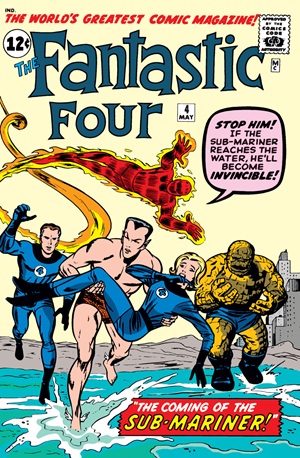
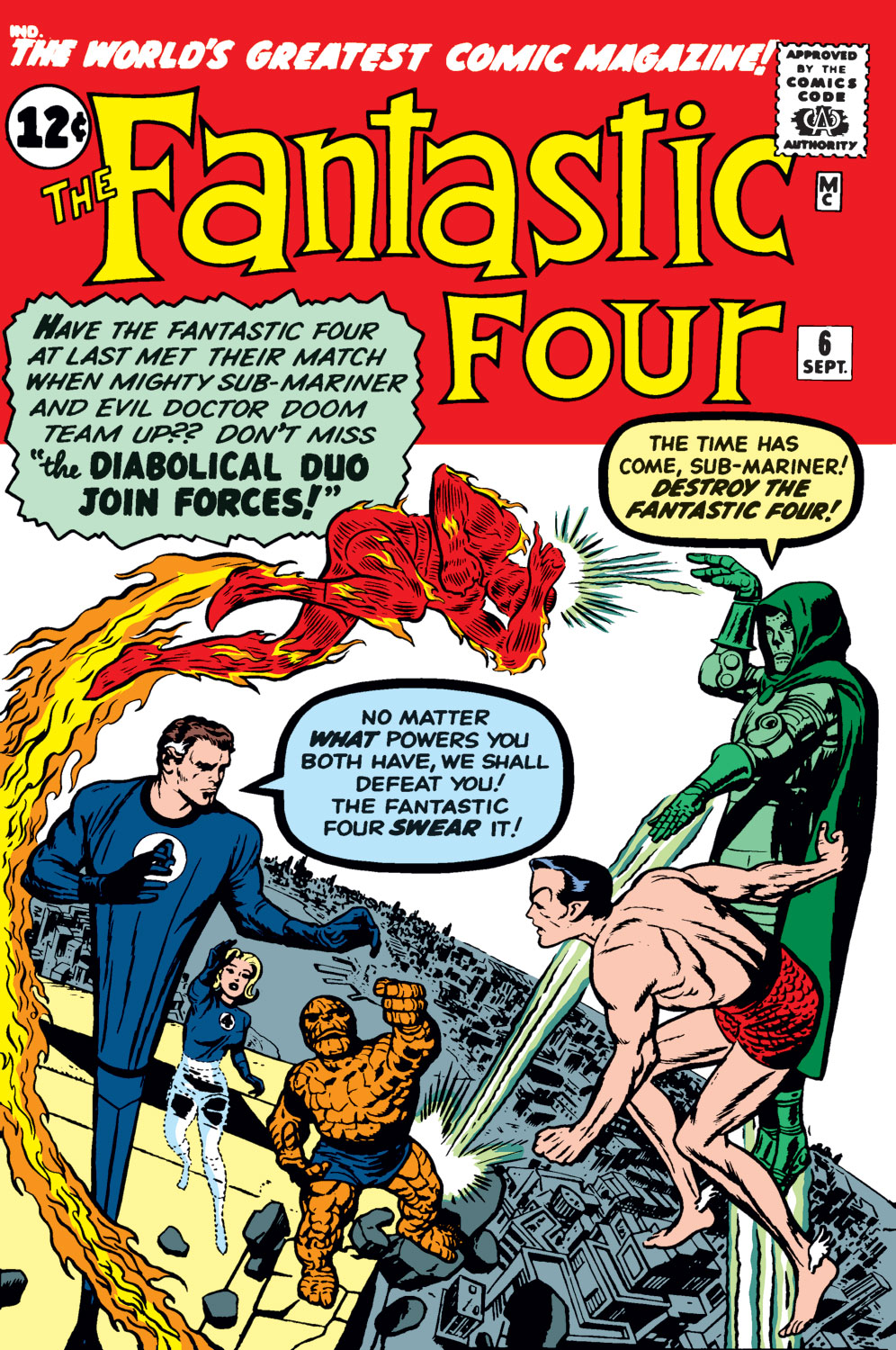
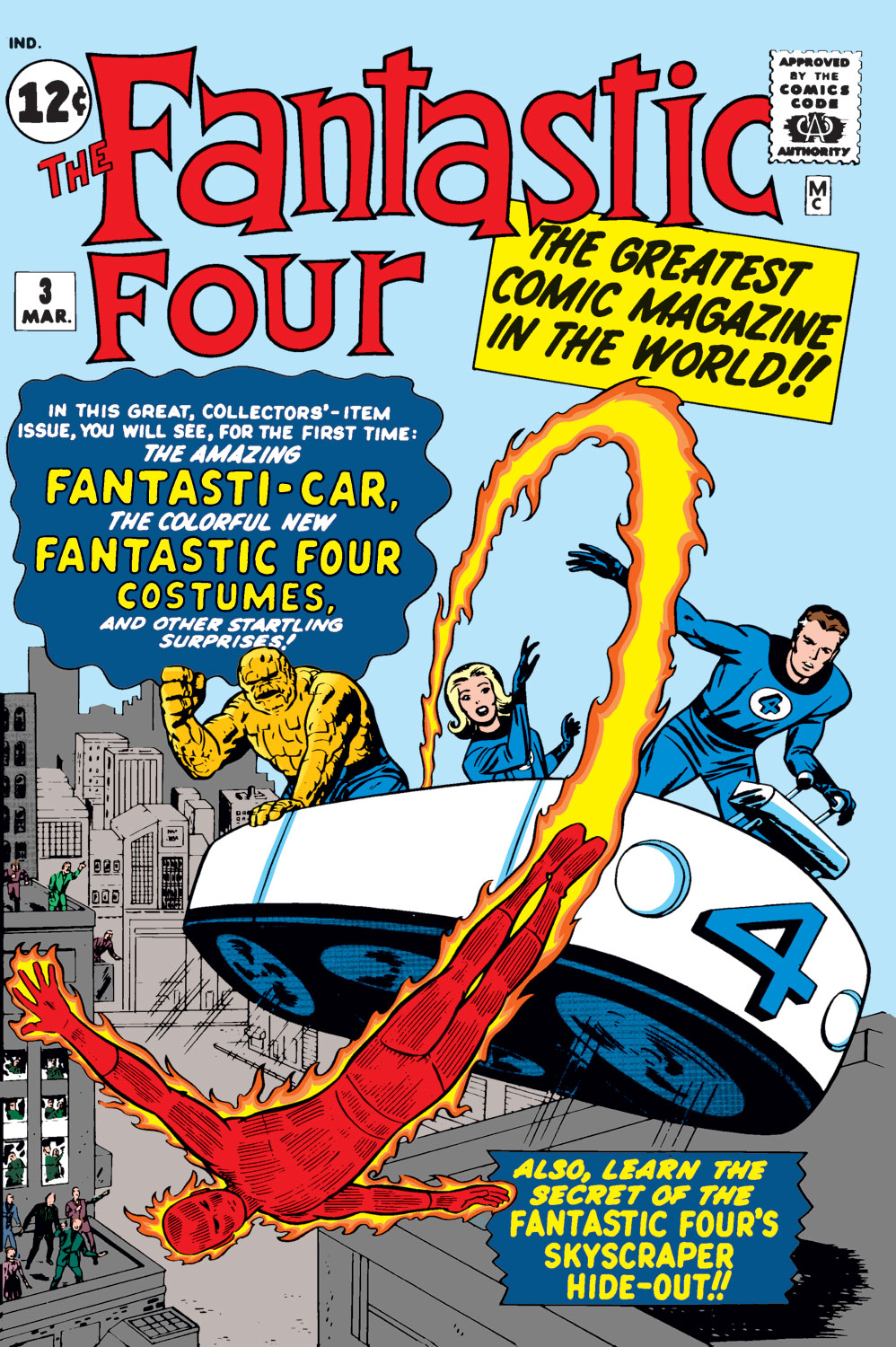
As you can see from the cover, this issue reintroduces Namor the Sub-Mariner, one of the three big stars of Timely Comics in the Golden Age of comics alongside the Human Torch and Captain America, to the modern Marvel Universe. With his arrival, we also get the first and most significant romantic tension between Sue and Reed (not counting Ben’s crush on Sue, which is all but forgotten after the early issues). Bonus: Johnny adopts a catchphrase (and uses it a lot).
Before we meet Namor for the first time (again), the group is still reeling from Johnny’s petulant departure at the end of the last issue. Ben—now in shorts, having shed even more of the outfit Sue made for him—dashes off another “bah!” before essentially saying “good riddance,” to which Sue responds with sisterly concern before Reed redirects his finger from “somewhere out there” to Ben or, should I say, “Thing.”
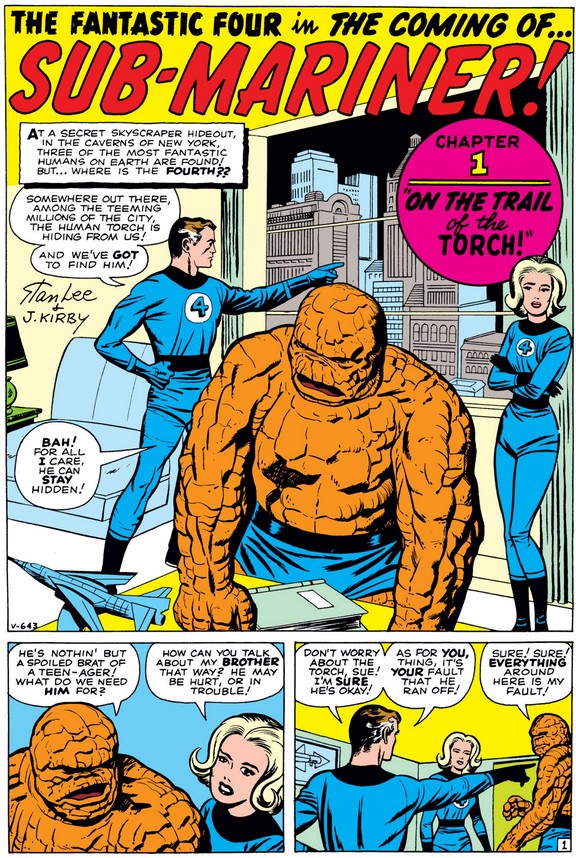
Calling him “Thing” makes some sense here, given that Reed is angry with him, but we’ve seen that they all call him this often, which as I’ve noted before seems cruel in light of his uniquely extreme transformation. (The full extent of his self-loathing, discussed in chapter 5 of my book, is yet to come, but this can’t be helping.)
Ben tries to deflect the blame through exaggeration, but Reed is determined and precise, fingering (sorry) Ben’s jealousy at Johnny saving the day. Ben is not calmed, but it is hard to tell if he disagrees with Reed or knows all too well that he’s right. (Likely both.)
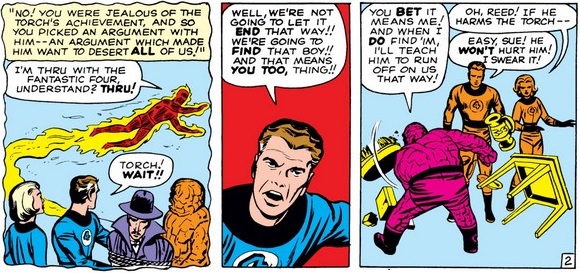
Regardless, it’s encouraging to see that Reed has faith in Ben to control himself when they find Johnny, a rare early reflection of their close friendship, which has yet to be highlighted as much as it is in later issues.
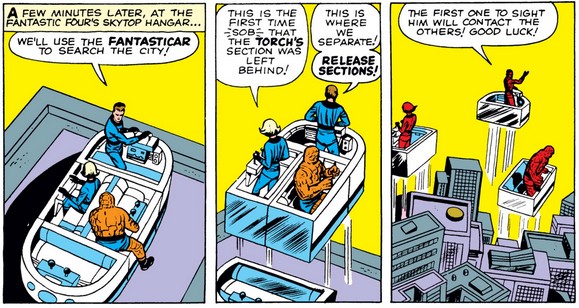
Again, we see a cool feature of the Fantasticar shown almost in passing. It strikes me as odd that Ben is assigned to a section to one side rather than in the back, but I suppose Reed would have to adjust his flying to even out the weight in any case. (Any pilots out there care to chime in? Might it be easier to control for pitch than roll?)
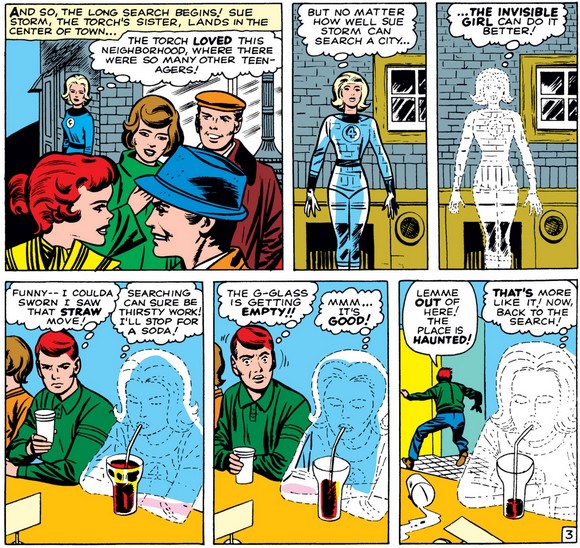
As each starts the search for Johnny, Sue remembers that the cool kids all hang out in “the center of town” (Washington Square Park? Union Square? Times Square?), a neighborhood that Johnny “loved.” (Yikes—even Ben ain’t that grim.) After searching for what must have been minutes, she takes a break for a soda and a chance to freak out the locals (as she did in the opening pages of the first issue).
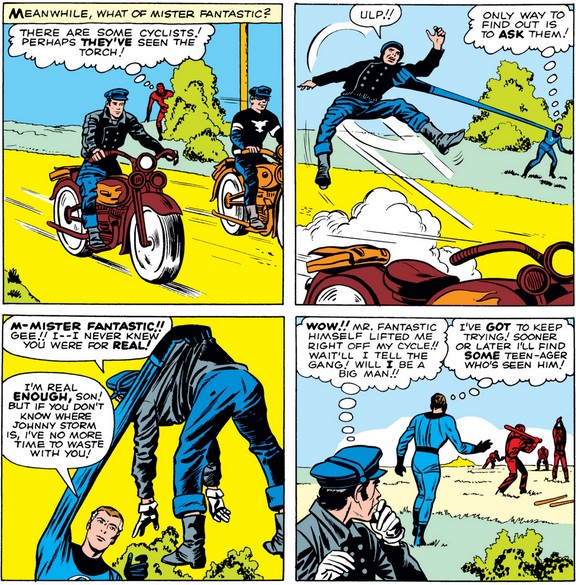
For his part, Reed seems to have gone to a park to grab passing motorcycle riders off their bikes to question them about Johnny. I’m relieved the one below is grateful for the experience, but you have to wonder if his bike’s OK—and how Reed managed the leverage necessary to lift the guy off of it from that far away.
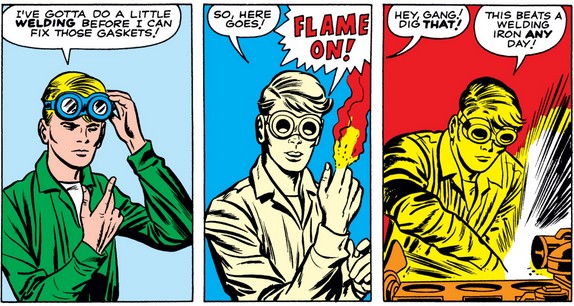
Unfortunately we don’t get to see his hijinks on the baseball diamond, because the scene shifts to Johnny himself, who’s fooling around with a car in a nearby garage with his chums and showing off the precision of his flame—as well as uttering his famous catchphrase for the first time (and in red block letters, no less).
I think his next feat is a bit reckless, regardless of how experienced he is with his flame by the fourth issue. (What’s more, I don’t think lighting your entire body on fire is going to be very useful for any welding jobs, kid.) Fortunately, in this case, we don’t find out what Johnny would do next, because Ben finds him easily, suggesting he knows Johnny better than either Sue or Reed (and he didn’t stop for a soda on the way), and he is reasonably skeptical of Johnny’s ability to control his flame around gasoline.
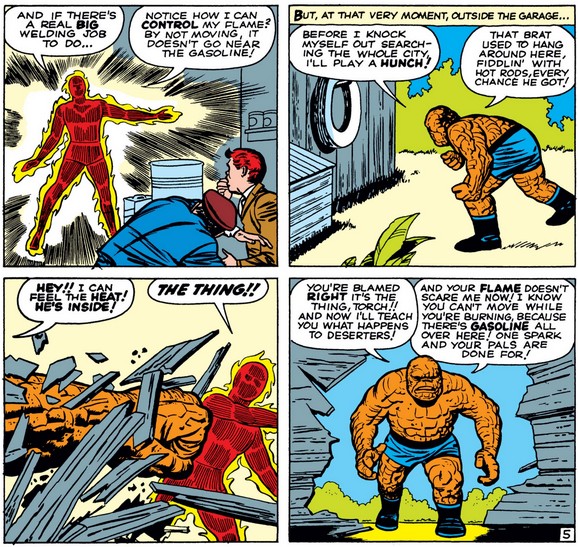
In an effort in persuade Johnny to “flame off” (a phrase he actually used in the last issue), Ben plays Superman in what certainly seems to be an homage to the famous cover of Action Comics #1 (as noted elsewhere).
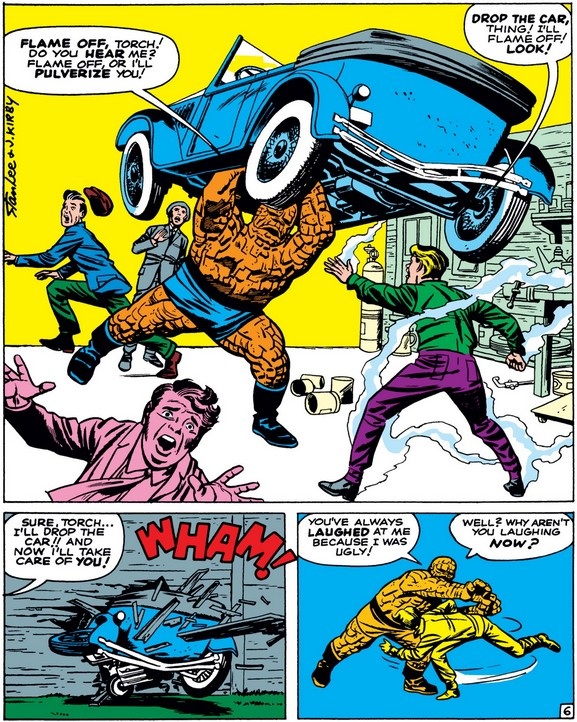
Perhaps Reed was too hopeful earlier, because Ben certainly seems determined to hurt Johnny here, primarily (it seems) out of resentment for comments about his looks.
After he promises not to mess up Johnny’s face, though, Ben experiences his second random transformation (after issue #2), which makes him forget all about Johnny (which is fair, I think) and lets Johnny get away (to silently express either pity or snark).
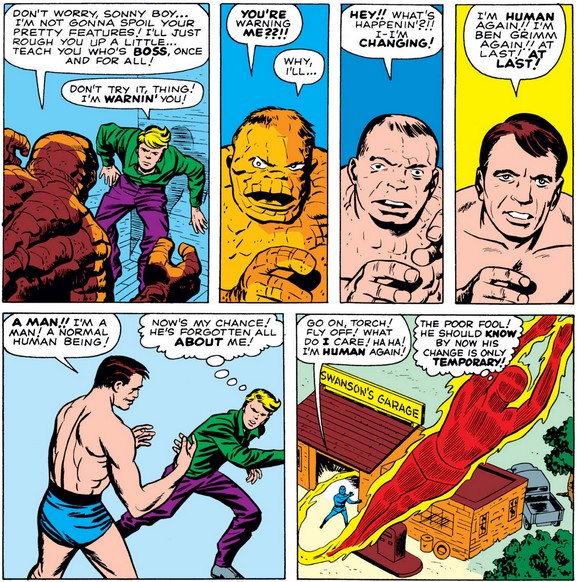
Johnny was more right than he probably knew, and if he hadn’t flown away so quickly, he would have seen Ben collapse in heartbreaking despair…
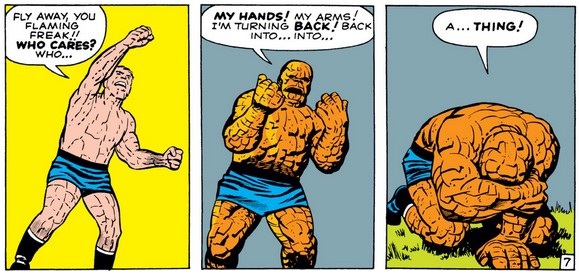
…or “helpless rage,” as the exposition below says. We also see Johnny land in the Bowery, a neighborhood on the Lower East Side of Manhattan that was known for nearly a century as New York’s “Skid Row” (until inevitable gentrification starting in the 1990s), and which connects with Delancey Street, the real-world inspiration for Yancy Street (where Ben grew up, though it has yet to be mentioned).
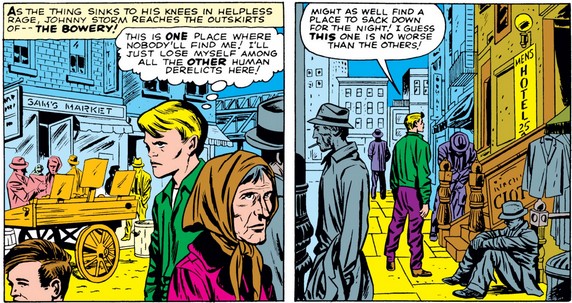
Insensitive as Johnny sounds in the first panel above, note that he says “the other human derelicts,” suggesting some self-pity on his part as well.
After securing a bed, Johnny leafs through a Golden Age issue of Sub-Mariner Comics (although I can’t find an issue whose cover shows anti-aircraft cannons behind him, although there are a lot of covers depicting him around Nazi battleships). While this is not the first mention of other Timely/Atlas/Marvel Comics—Reed used monster stories from contemporary Marvel Comics in issue #2 to scare invading Skrulls away from Earth—this is the first time that they are shown to depict people who existed in the Marvel Universe. (Strangely enough, Johnny hasn’t yet mentioned the original Human Torch, Jim Hammond, as the inspiration for his own name, although it is in his own feature in Strange Tales that Captain America is first referenced in the modern Marvel Age, several months before he is revived in Avengers #4, with the help of a certain sub-mariner, no less.)
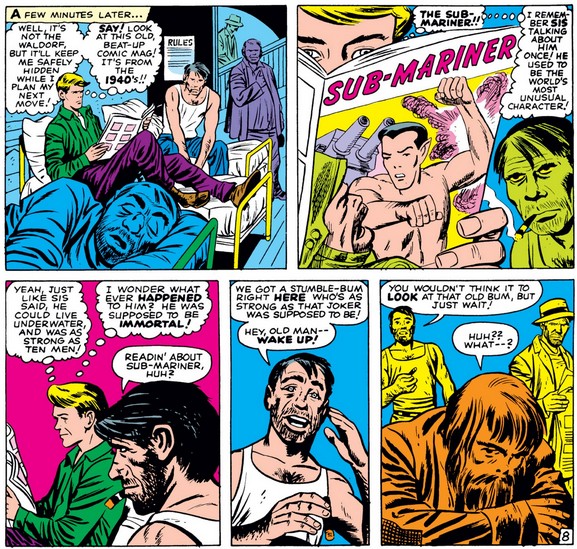
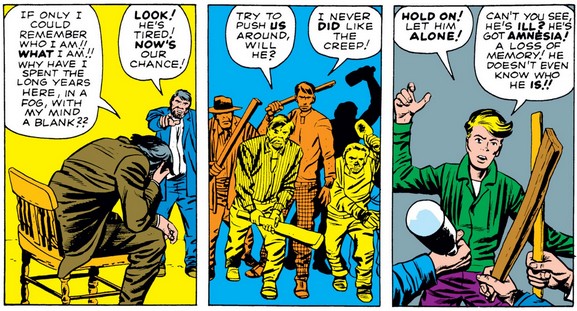
After the other men try to goad the “old bum” into demonstrating his strength, he fights them off, and when the others see a chance to attack, Johnny defends him, showing admirable sympathy for the clearly suffering yet dangerous stranger.
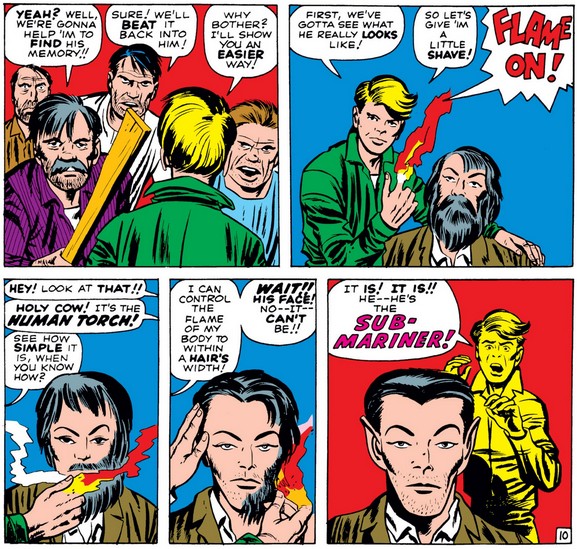
Pretending the other men care as much as he does about stranger’s identity, Johnny shows what else his welding finger can do—and uses his catchphrase again—before discovering the old bum looks just like how his creator and regular Golden Age artist Bill Everett drew him (assuming that’s all Johnny had to go by when he recognized him).
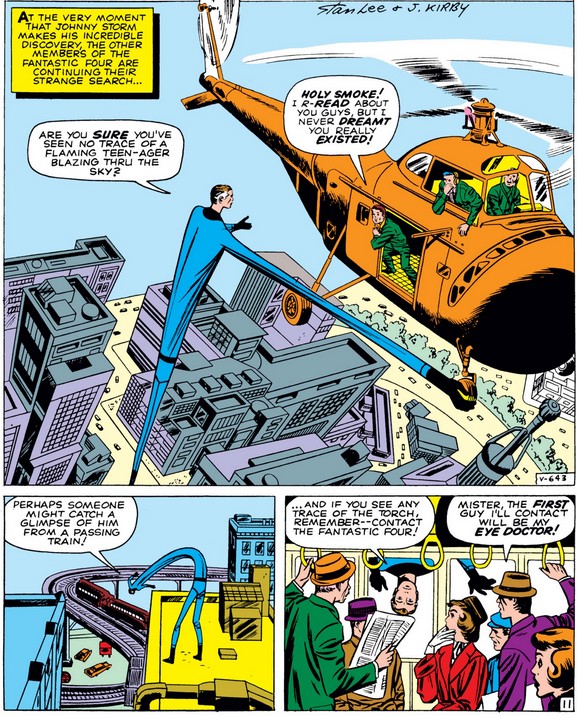
We’ll have to assume Johnny closes his mouth eventually, as our focus returns to Reed, apparently stretching hundred of feet into the sky to ask helicopter passengers if they’ve seen a “flaming teen-ager” in the sky. (This is more reasonable than interrogating random bikers or, as he also does below, train passengers—surely not while the train is moving, though?) I trust he’s holding onto the wheel to steady himself rather than the copter, but how can they possibly hear each other over the rotor noise?
Sue finally finds herself in the Bowery, despite her doubts that her baby brother would ever frequent such a place—doubts so strong that she ignores his voice right behind her (and the handsome stranger with him).
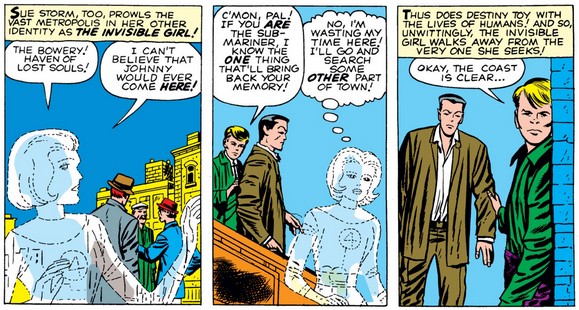
Johnny says “Flame on!” for the third time this issue—he must think an angel gets its wings every time he says it—before helping Namor regain his strength and memories by dumping him in the drink…
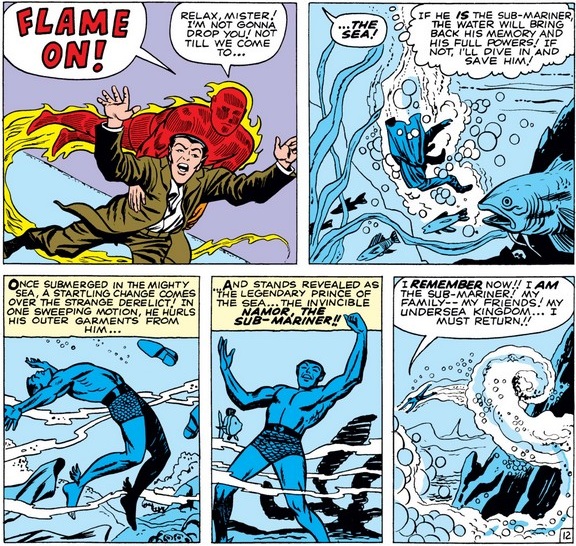
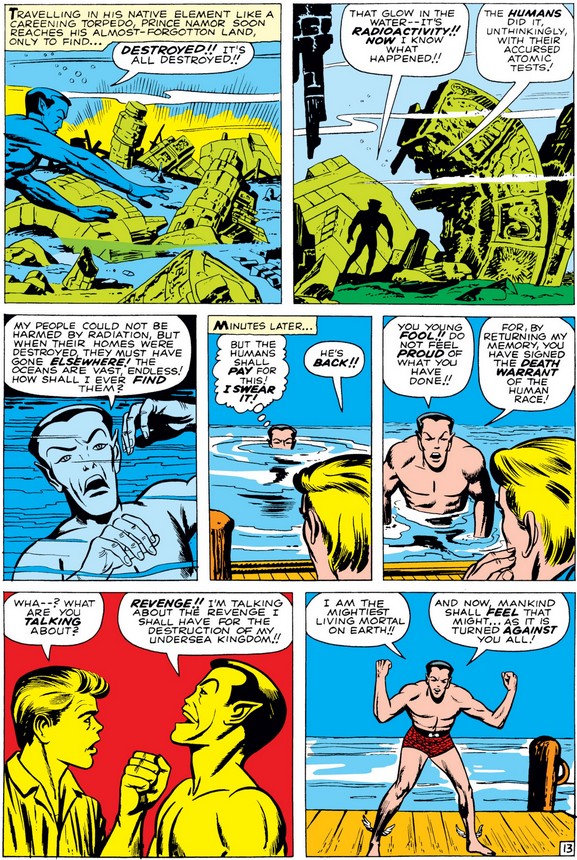
…which, while generous and selfless, nonetheless backfires as Namor finds his people missing, reigniting the hatred of humanity that led to him fight the original Human Torch in 1940’s Marvel Mystery Comics #8, the very first superhero “crossover” (several months before the Justice Society of America formed in All-Star Comics #3).
Johnny sends off a signal flare, described below as a “secret symbol.” (You may think it’s the number four, but on Johnny’s world, it means “hope.”)
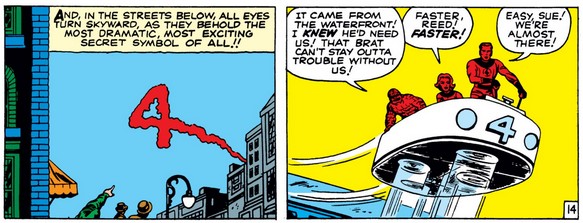
When the group reunites, Johnny doesn’t have time for niceties or criticism, rushing to tell them about the threat Namor poses…
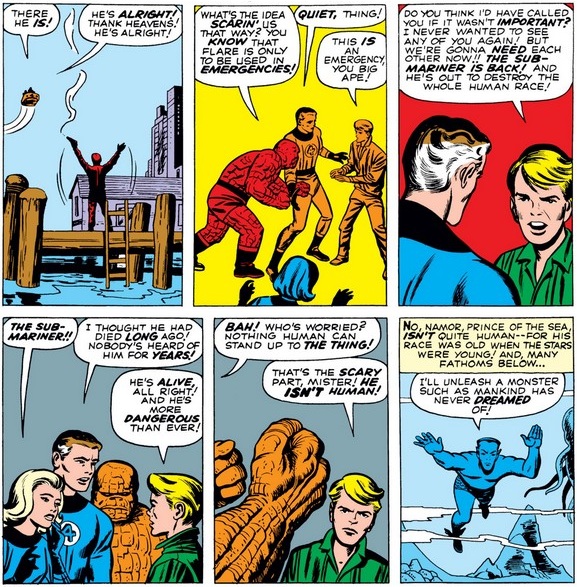
…though the part about “his race” being older than the stars is a bit of an exaggeration. (Namor is a human/Atlantean hybrid, like that other fishy fella, and although the origins of the Atlanteans in the Marvel Universe is… complicated… they ain’t that old.)
Oh, and that monster Namor mentioned? It’s Giganto, whom Namor controls with a “trumpet-horn” (although I usually just say trumpet), later identified as the Horn of Proteus. The army’s large artillery are useless against Giganto, as are Reed and Johnny…
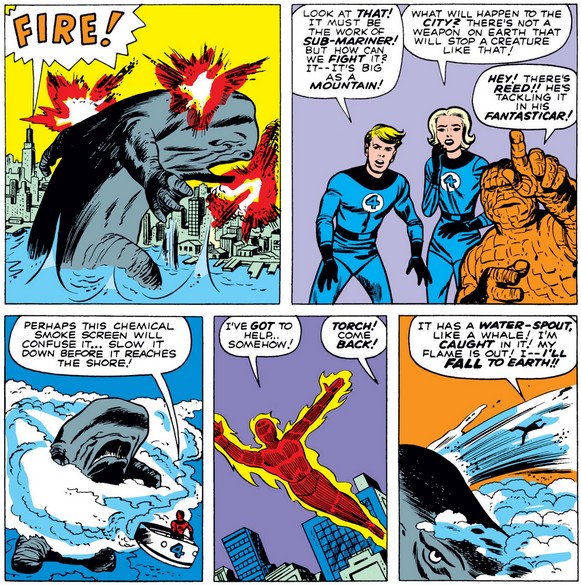
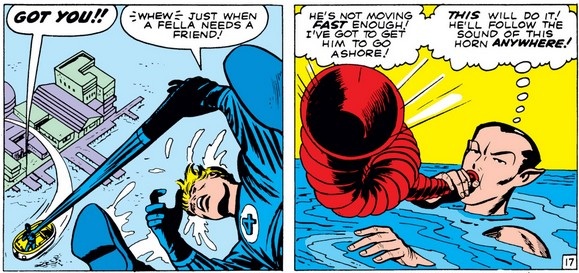
…but at least Reed saves the Extinguished Torch. (I really just wanted to show Namor’s horn, which may or may not be the horn with which Doctor Doom famously does as he pleases.)
Ben saying “One side, woman” (groan) and “I got me an idea” (which sounds more authentic than “bah!”) in the same speech bubble gives me a headache, but he demonstrates his heroism by preparing to deliver a massive nuclear bomb into Giganto’s gullet (like Jonah, whom he references later). He claims not to be a hero, as he often does in future stories, but in this case it seems more like obstinacy than humility. (And there’s Sue, calling him “Thing” again…)
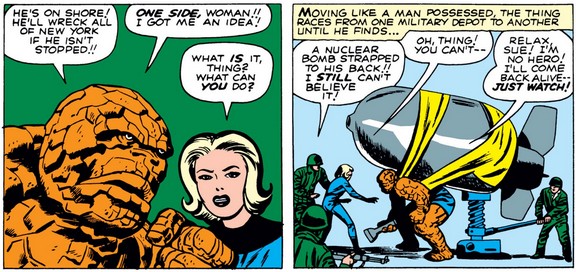
Two quick things: I like how Ben’s face is starting to take shape, particularly his emerging brow, as well as his rockier texture. (The lips will vanish soon, thankfully.) But how long did it take him to “race from one military depot to another”?
As Ben fights the smaller monsters in the belly of the beast, he mentions having fought “everything else in my time”… settle down, pal, it’s only (as I said before) the fourth issue.
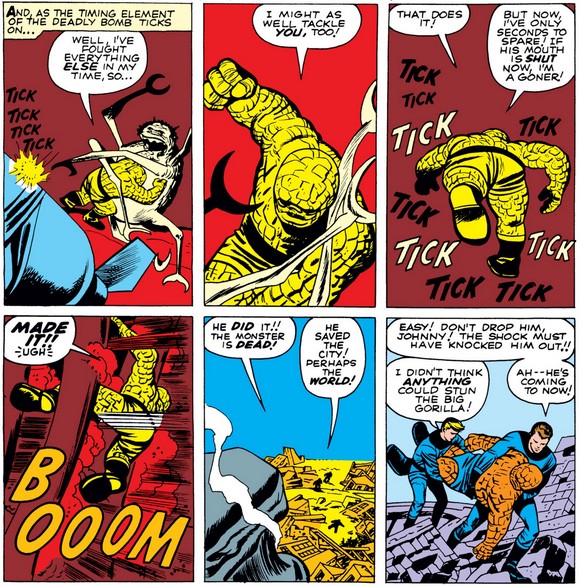
Ben’s heroism seems to have softened Johnny towards him a bit (although the gravity of the situation may have helped too), and Ben dismisses his praise with a joke (as will become typical of him, just like with “accusation” of heroism). And Reed finally gets a glimpse of Namor, who was commanding Giganto from underwater the entire time.
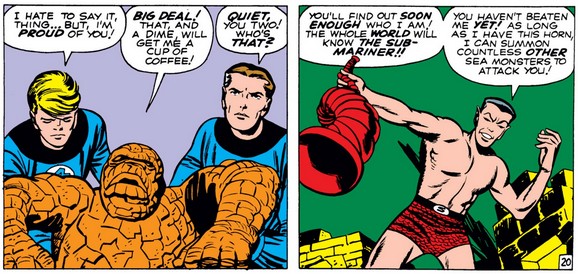
Namor says too much and yoink, the horn is gone. While Sue can make her clothes invisible, she apparently doesn’t realize she can do the same with the horn…
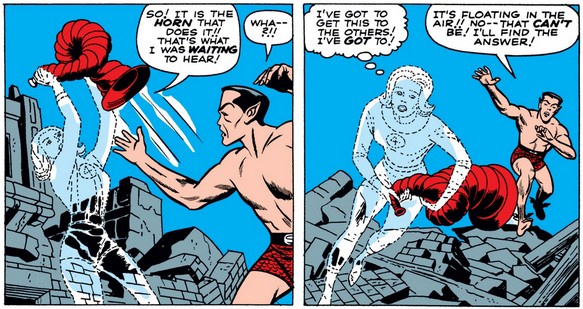
…and Namor easily follows and catches her, leading to the final panel below that adds a significant new element to the storyline for both of them (and Reed) going forward.
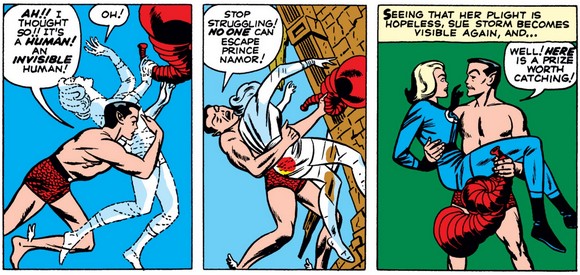
Namor shows how deep his newly rediscovered hatred of the human race runs when he offers to set it all aside if this women he literally just met marries him. Sue seems too ready to consider it, but Reed lets her off the hook by pledging to continue defending the world against Namor.
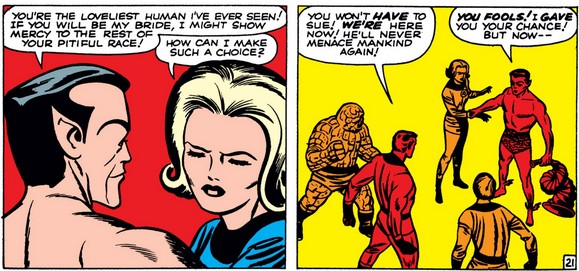
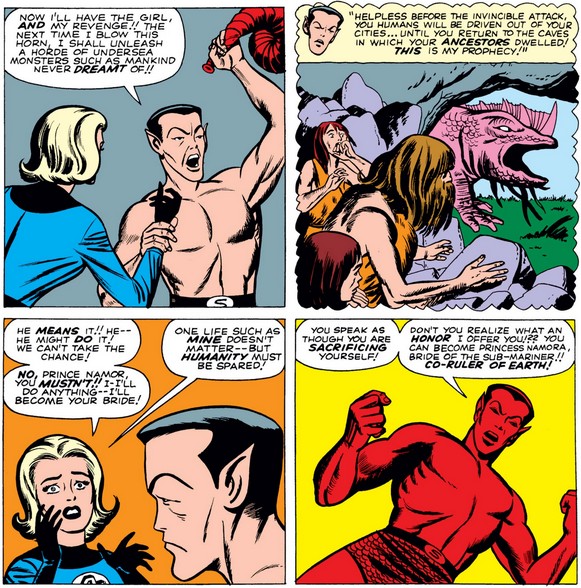
Namor sees Reed’s bluster and raises, retracting his offer and instead threatening both the surface world and Sue’s freedom. She offers to sacrifice herself to save the rest of humanity, but Namor is offended she considers it a sacrifice at all—and given the attraction she shows for him soon, she might not have been entirely sincere about the nature of this “sacrifice” anyway.
After waiting to see what Sue would do—which can be seen as either an admirable respect of her autonomy or a cowardly refusal to defend her, depending on how you look at it—the other three attack Namor…
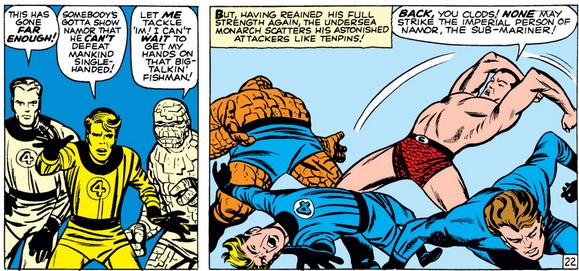
…and get their asses handed to them but bad. (This includes Ben, who looks to be smarting from Namor’s single blow.)
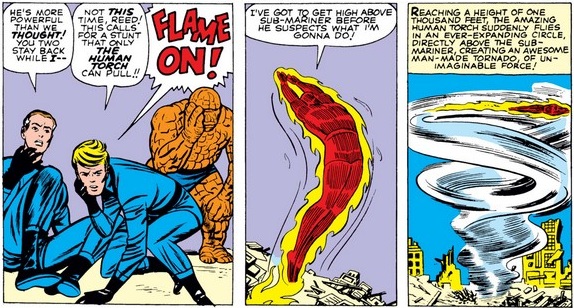
Once again, it falls to Johnny to save the day, creating an air vortex strong enough to lift both Namor and whatever was left of Giganto and dump them back in the ocean, where the Horn of Proteus is “lost forever” (it isn’t) and Namor swears to return (he will).
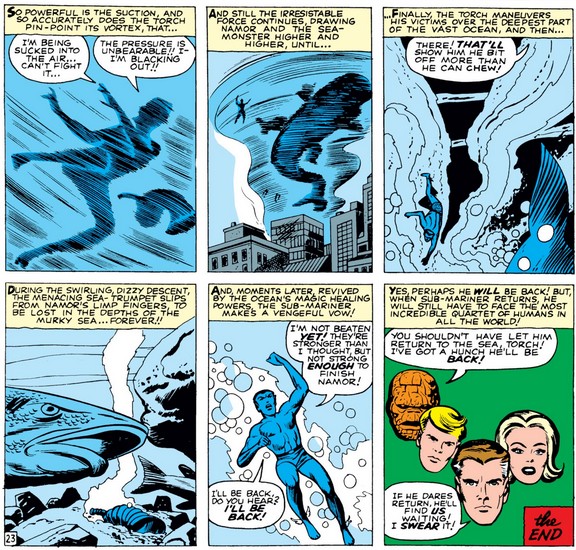
Ben makes a good point: Why did Johnny think returning him to the sea would defeat him, after earlier in the issue he did the exact same thing to restore his strength?
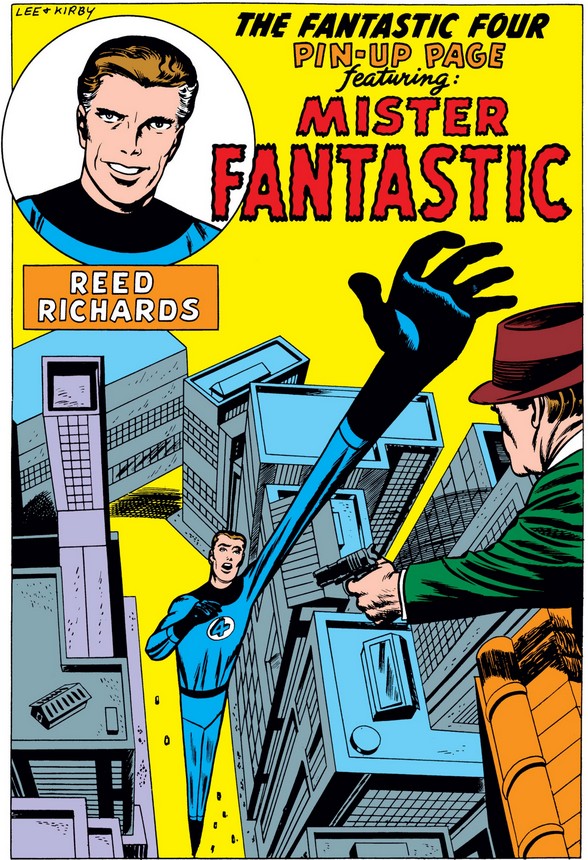
As the last two issues did, this one ends with a portrait, this time of Reed. demonstrating his vertical reach (also seen in the story) but prompting the reader to wonder what would happen if the gunman shot him. (We saw him dodging bullets in the last issue, but have yet to see him let them hit him and stretch his elastic form.)
Resources for this issue:
- Marvel Comics (to read the issue online; free if you have Marvel Unlimited)
- Marvel wiki at Fandom (with detailed annotations and links to related comics)
- Fantastic Four: The Great American Novel (an amazing website with fascinating annotations)
- The Fantasticast (a wonderful podcast covering each issue one at a time)
- For a thorough list of Namor’s appearances, see this reading guide. While I have not yet written anything on him specifically, the Sub-Mariner is mentioned often at The Virtues of Captain America Blog, especially in his WWII-era adventures with the Invaders, his occasional spells with the Avengers, and Cap’s guest appearances in Namor’s own titles.
- Print options:
- Fantastic Four Epic Collection: The World’s Greatest Comics Magazine (paperback collection containing issues #1-18)
- Marvel Masterworks: Fantastic Four Volume 1 (hardcover collection containing issues #1-10, also in paperback if you can find it)
- Mighty Marvel Masterworks: Fantastic Four Volume 1 – The World’s Greatest Heroes (same thing as above, in paperback and smaller trim size)
- Marvel Comics Library: Fantastic Four Volume 1, 1961-1963 (oversized hardcover containing issues #1-20 and extensive background notes, essays, and pictures)
- Fantastic Four: Penguin Classics Marvel Collection (faux literary collection containing assorted issues with a scholarly introduction)
 Here's the Thing...
Leave a comment