
I have to admit, this is more than a little intimidating.
The first issue of Fantastic Four—the comic with which Stan Lee and Jack Kirby launched the modern Marvel Universe back in 1961—is one of the most discussed and analyzed comics ever, due to both its immeasurable impact on superhero comics and pop culture as well as the mystery behind its creation and structure. What can I possibly add to this discussion (much of which I list at the end of this post)? We shall soon see!
My main interest in this issue, as reflected in my book, is in how it lays the groundwork for the characters going forward. It has long been my contention that most of the key concepts that have defined the book and team for over sixty years were established in the first ten issues (give or take). Obviously, many were missing in this first issue, such as costumes, their public notoriety, and the Baxter Building (and their New York City home in general). Nonetheless, there are glimpses into our four heroes’ personalities and character traits that were built on later by Stan and Jack, as well as every creator that worked on the book (and other media).
Also, there are just really cool or funny things that I would like to draw attention to, like one fan talking to another (which is all I intend for this blog anyway).
For example, here’s the top of the first page, with portraits of the four (pre-flight, at least based on Ben’s pretty mug):

The main thing that sticks out to me there is Reed’s appearance, which looks neither young nor handsome, as Stan describes him in his synopsis (printed in Fantastic Four #358 and elsewhere):

I don’t want to get into the extensive debates over the authenticity or dating of this document or what it does or does not prove about the relative contributions of Messrs. Lee and Kirby to the concept of the team: there’s plenty of that here (about 80% down the page, at the heading “The synopsis to FF #1”).
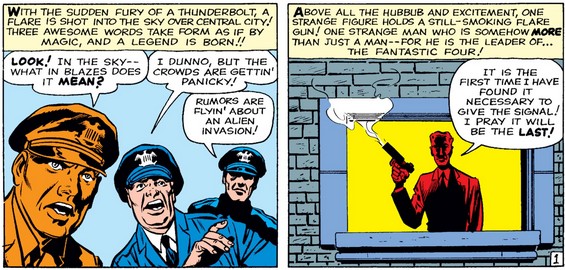
At the bottom of the first page, we see a shadowy Reed who has just fired off the flare seen above, which apparently announced the group’s name and existence for the first time, based on the officers’ reactions (as well as Sue’s comment below).
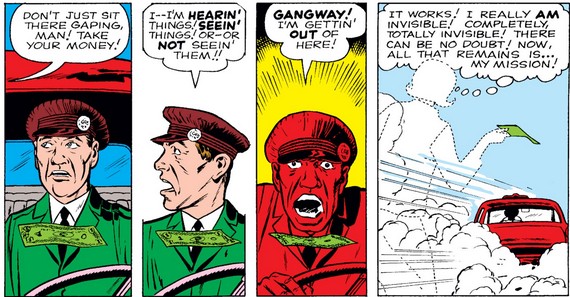
Elsewhere in Central City—not New York at this point—Sue sees the flare and recalls her “vow” (more on this to come), taking her heroic obligation seriously despite some apparent hesitation.

Below she plays a trick on the cabbie, but I have to wonder if she had never tested her powers before now. She obviously knows how to make her clothes invisible without doing the same to the money in her hand, so her control must be intuitively precise at this point. (Note her devotion to “the mission” is mentioned again, belying any assumption readers may have that she is not as serious about heroism as the men in the group are.)
Elsewhere, Ben is having a hard time finding really big-and-tall sizes. (Things haven’t gotten much better in that regard in the last sixty-odd years, I’m afraid.)
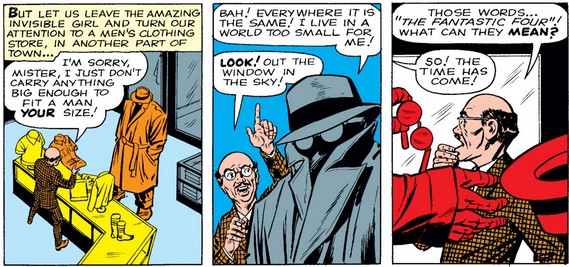
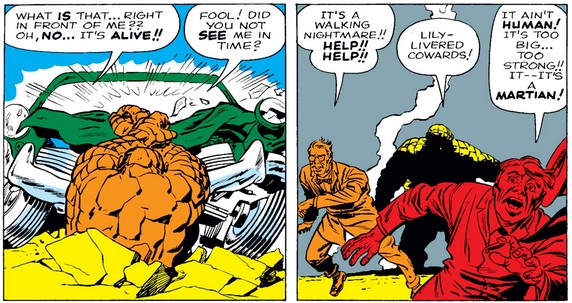
What I find most interesting about the panels above and below is his repeated utterance of “Bah!” He does not yet have his Lower East Side patois that will become so familiar later, instead saying things like “I cannot delay!”…

…and “did you not see me in time?” (At least “lily-livered” is something I can hear him saying later.)
Next we’re introduced to the final member in a garage, getting a tune-up to his coupe and preparing to reveal the only thing this teenage boy likes more than cars…
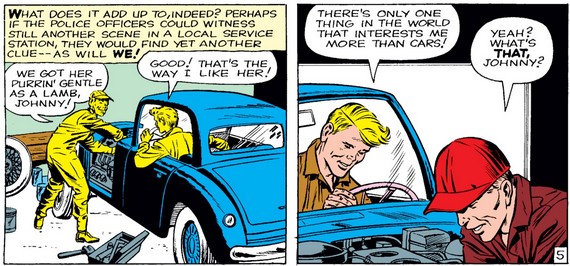
…which, it turns out, has nothing to do with dating. Later, Johnny is consistently shown to be the one of the Four who most enjoys his new life, but for all we know he could mean the mission itself (like his sister holds dear).

Both the mayor of Central City and the federal authorities in Washington are alarmed at the flaming figure and (instantly) send fighter jets after him.

We see above that Johnny is very concerned for the pilots’ safety, an early sign of his awareness of the danger his powers pose to those around him (a major theme of chapter 3 in my book).
After Reed rescues Johnny from the missile (which he tosses into the ocean), the two join Sue and Ben, at which point Reed prepares to explain the reason he summoned them. But first, we have an extended flashback to explain their origin—which brings up the oft-debated issue of why the story was structured like this and what it implies about the creation of the book. (I have no horse in this race; for discussions, see Tom Breevort’s posts linked at the end of this post.)
I have more to say about the initial presentation of the team’s origin itself, even if much of it will be familiar—such as Ben’s warnings about the cosmic rays and their insufficient knowledge about them (as well as the amount of shielding Reed put on the rocket, as mentioned later). The fact that Ben was the one most concerned about cosmic rays and the one most seriously affected by them was a significant factor contributing to Reed’s ongoing guilt over the whole affair (as discussed in chapter 1 in my book).

Also of significance above is Sue’s goading Ben into going by calling him a coward, which is all the more effective given his feelings for her, to be revealed later. She goes on to feel a fair bit of guilt about this, and has since apologized (if only very recently).
Once in space, the cosmic rays hit the ship, and the insufficient shielding is mentioned (by whom, we have no idea).
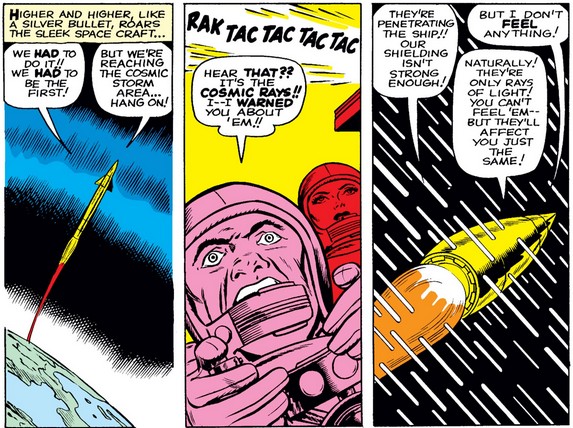
Can we assume it is Reed who below admits Ben was right about the shielding? It would fit with his tremendous guilt afterwards, but it could have been Sue or Johnny as well; the effect on Reed would be the same.

After crash-landing back on Earth, Reed acknowledges the possibility of effects from the cosmic rays, and as if on cue, the transformations begin, starting with Sue. (Actually, before the landing Johnny started to feel hot and Ben found it difficult to lift his arms, but they seemed OK once back on Earth until they changed completely.)

I’m not sure what her “atomic structure” has to do with whether she’s visible or not, but OK; these days it’s usually understood that her invisibility powers allow her to affect light, which has been used recently to enable her to change the color of visible objects as well.
Ben challenges Reed’s expression of relief, concerned about not only Sue but the all of them. Reed gets very defensive, taking Ben’s reasonable questions as an accusation about the flight itself (suggesting he already feels guilty about it) and inspiring a violent reaction from his best friend.
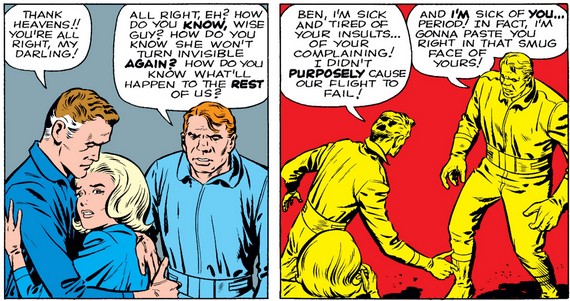
Perhaps it was Ben’s anger at Reed that triggered his transformation, both enabling his violent impulses and prompting Sue to brand him a “thing” for all time.
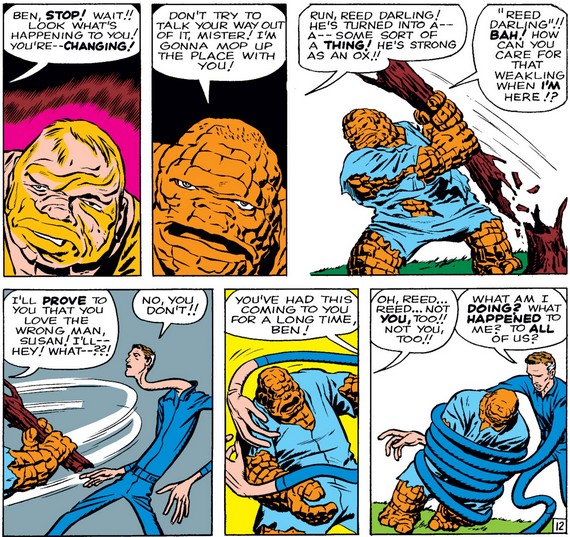
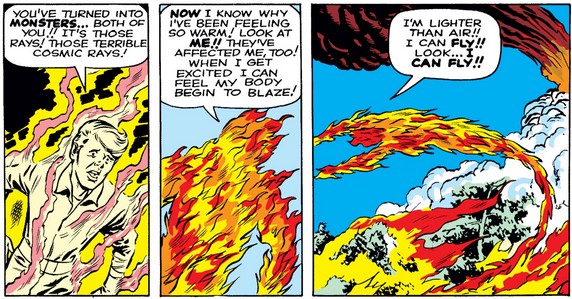
We also get the first explicit statement of Ben’s feelings for Sue as he lashes out at Reed, which reveals the latter’s change, far less dramatic than the first two, much less the final one, shown below. Interesting that Johnny calls both Ben and Reed “monsters” before he admits he’s been feeling warm all this time and flames on when he gets excited. (Both are confirmed much later: Johnny always feels hot and has to be ever diligent not to lose control of himself.) Nonetheless, he is the happiest about the cosmic ray effects (sounding a bit like Peter Pan), which remains consistent throughout most of the team’s history.
In the grand conclusion to the origin, which in its entirety takes up all of five pages, Reed launches into his Central City Address, about to say something about great power and great responsibility, but Ben beats him to the punch (with the “gotta” sounding more the Ben we know and love). Their mission (and presumably the “vow” Sue referred to above) is set: to use their powers “to help mankind.” This is a noble but vague statement of intent that echoes classic utilitarianism—the school of ethics that tells us to do that which creates the most happiness for the greater number of people—but leaves many specifics to be filled in later. (I discuss the team’s mission and utilitarianism, as well as the perennial question of whether they are better described as explorers or adventurers than heroes, in the first chapter of my book.)
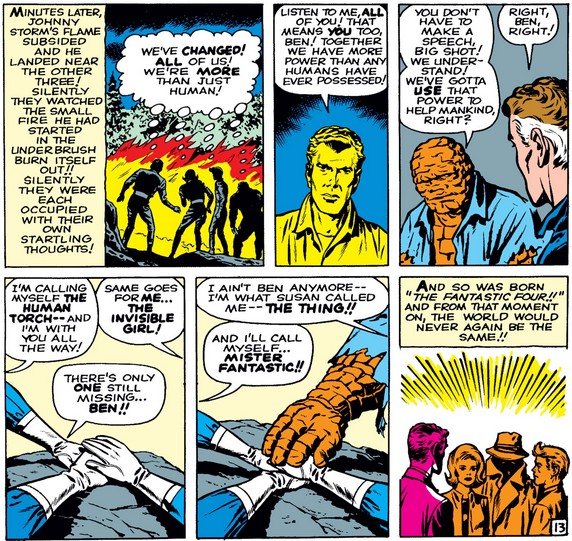
Later, it is revealed that Johnny was indeed thinking of Jim Hammond, the Golden Age Human Torch and the cover star of the very first Timely comic, Marvel Comics #1, when he adopted his superhero name. Ben took his name from Sue’s offhand comment earlier, while hers is fairly on-the-nose. As for Mr. Fantastic, Reed explained later that he took on that self-congratulatory name as part of his larger plan to make them all lovable celebrities rather than feared monsters and thereby make up for the way his mistake changed all of their lives forever. (His guilt extended far past Ben, even though the rest of them were able to hide or control their powers.)
After the origin is finished, we return to the crisis Reed summoned them to face: sinkholes appearing around the globe, from which monsters resembling Lee and Kirby’s typical 1950s fare were emerging, all controlled by the Fantastic Four’s first foe, the Mole Man (here spelled as one word, though, like Spider-Man would be in his first appearance).
After traveling to Monster Island, Reed and Johnny fall into yet another sinkhole, leaving Sue and Ben to fight a monster on land. This is no problem for the Thing, who then rubs it in Reed’s absent face (with a subtle jab toward Sue having chosen him over Ben), showing the tremendous resentment and anger (often mixed with self-pity) that Ben will feel towards Reed for some time to come.

Below, the Mole Man (née Rupert Elder, we later learn) explains his own origin…
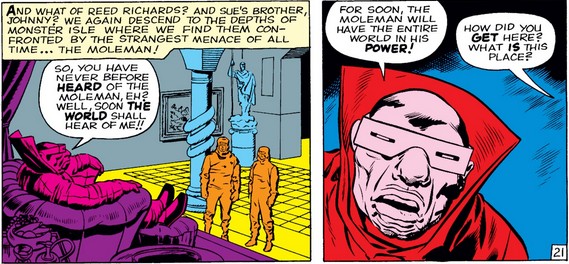
…having fled society for the subterranean world after being rejected by mankind for his unsightly appearance. This is a common theme in the Fantastic Four mythos, as seen also in Ben Grimm and Victor von Doom, with each of them dealing with it in his own way. (Oswald Cobblepot comes to mind, too, of course, but that’s a topic for another blog entirely.)
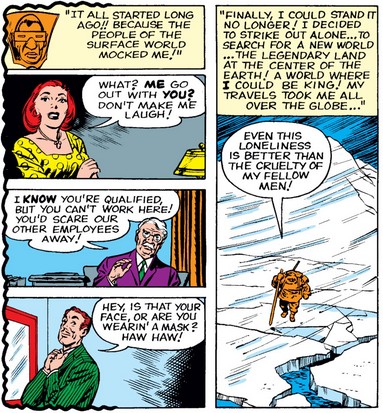
Soon afterwards, a bad fall caused Harvey to lose most of his sight, but in the mighty Marvel tradition, he developed a “natural radar sense” similar to a bat. (No radioactive waste necessary!)
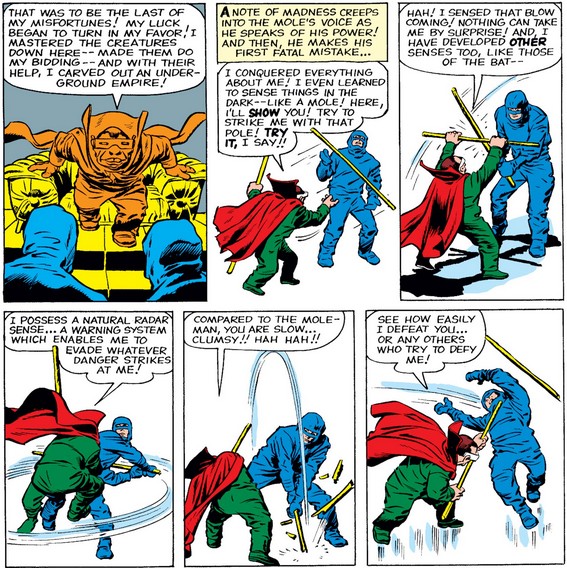
His sight aside, he fights amazingly well… perhaps he has a wooden dummy down there?
They are soon joined by Sue and Ben, and together the team manages to escape, with Johnny melting the rock behind them to seal Mole Man and his monsters in, after which Harvey apparently destroys the island (although no one seems to consider that he might have died to the explosion). Although it is Ben who later feels kinship with Harvey for obvious reasons—at one point joining his underground society—here it is Reed who expresses sympathy for him.
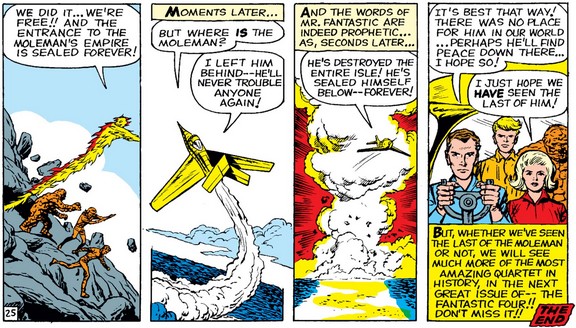
Whew!
Although this issue mostly set up the four characters, their relationships to each other, and the origin and nature of their powers, we did see glimpses of their personalities as well—maybe not so much for Reed, but as he takes charge of the team from here on, he will get his moments in the spotlight as well.
Resources for this issue:
- Marvel Comics (to read the issue online; free if you have Marvel Unlimited)
- Marvel wiki at Fandom (with detailed annotations and links to related comics)
- Fantastic Four: The Great American Novel (an amazing website with fascinating annotations)
- Homages to the cover to issue #1 (from the above website)
- The Fantasticast (a wonderful podcast covering each issue one at a time)
- Tom Brevoort, longtime Marvel editor and tremendous comics fan and historian, has many posts about this issue on his blog:
- A page-by-page, sometimes panel-by-panel breakdown of the issue in two parts (here and here), with particular attention to Kirby’s art.
- The two posts linked above also discuss the theory that the issue was assembled from two different stories, which is elaborated upon here and here.
- A four-part breakdown of the page proofs for the issue (part 1, part 2, part 3, and part 4).
- Print options:
- Fantastic Four Epic Collection: The World’s Greatest Comics Magazine (paperback collection containing issues #1-18)
- Marvel Masterworks: Fantastic Four Volume 1 (hardcover collection containing issues #1-10, also in paperback if you can find it)
- Mighty Marvel Masterworks: Fantastic Four Volume 1 – The World’s Greatest Heroes (same thing as above, in paperback and smaller trim size)
- Marvel Comics Library: Fantastic Four Volume 1, 1961-1963 (oversized hardcover containing issues #1-20 and extensive background notes, essays, and pictures)
- Fantastic Four: Penguin Classics Marvel Collection (faux literary paperback collection containing assorted issues with a scholarly introduction)
- Fantastic Four No. 1: Panel by Panel (hardcover edition of issue #1, with each panel photographed from an original comic and presented on its own page, with an essay from Tom Brevoort adapted from the blog posts linked above)


 Here's the Thing...
Leave a comment