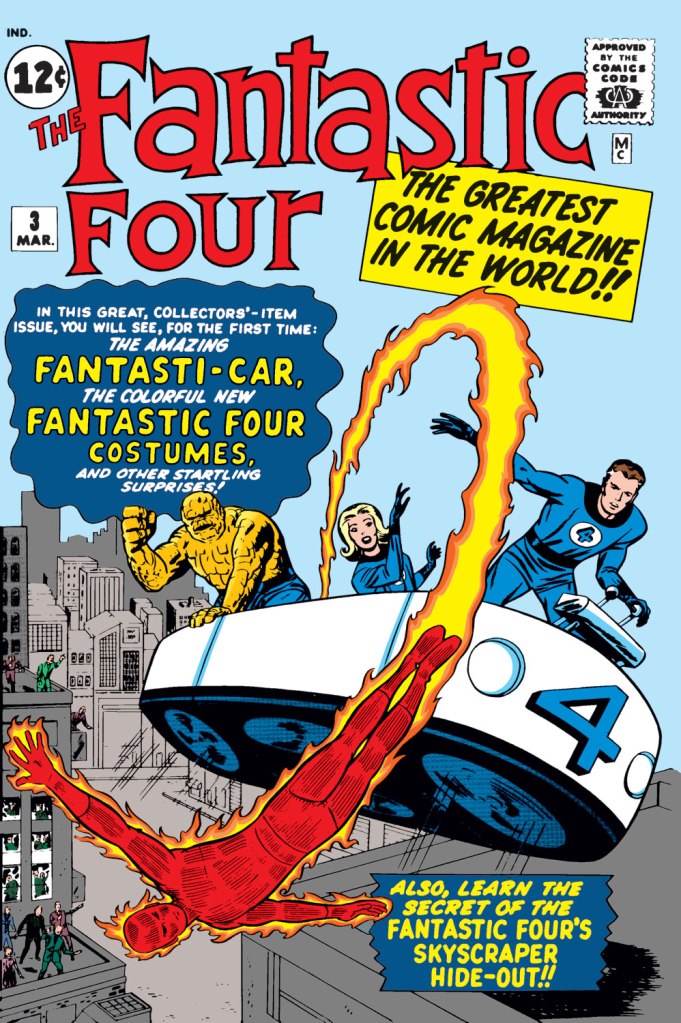
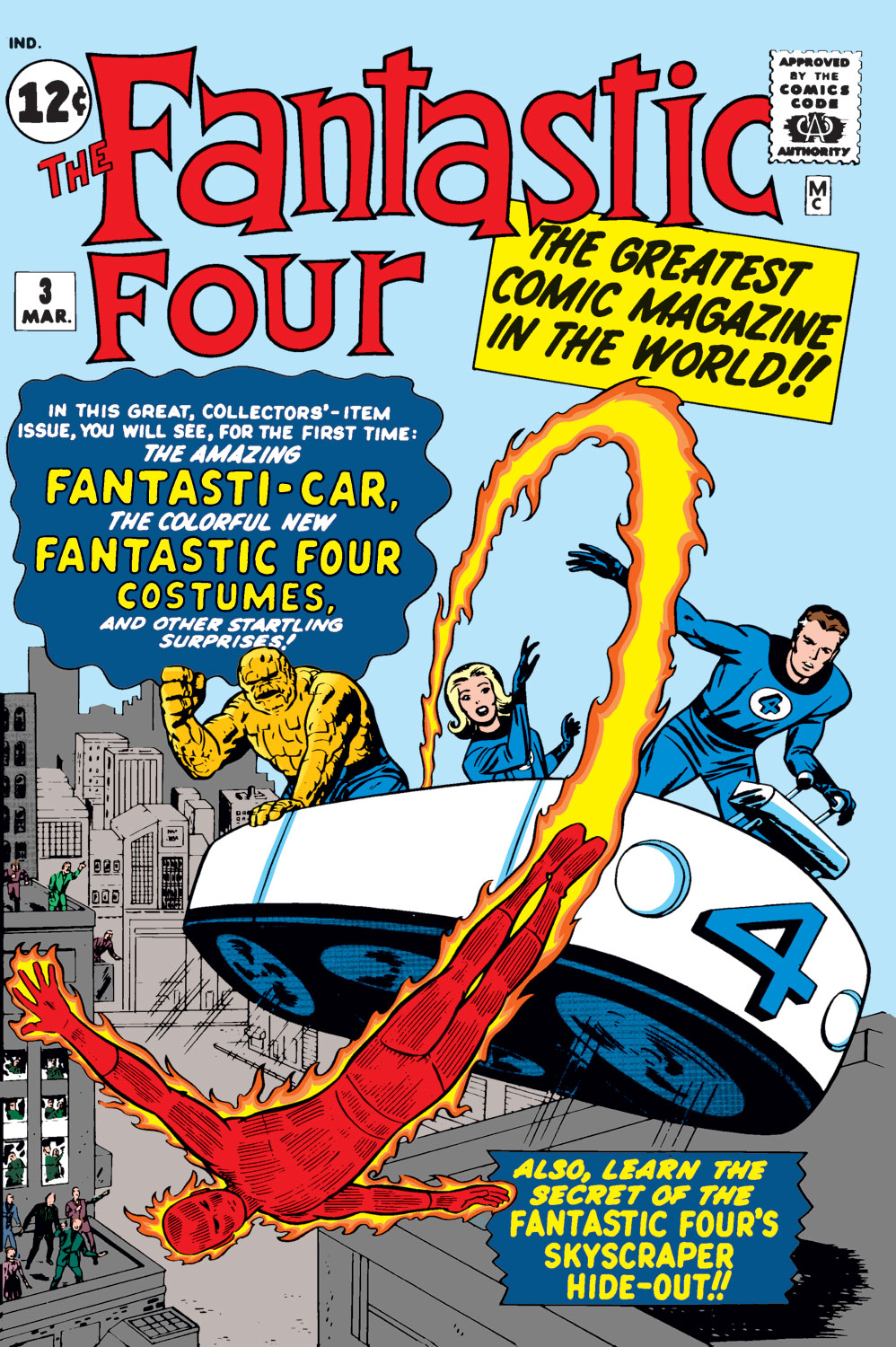
As you can see from the cover—heralding, for the first time, The Greatest Comic Magazine in the World—this issue brings three more important elements into the Fantastic Four world: the costumes, the ride, and the headquarters (hyped at the bottom). We also see each member express heroism in their own way, while reinforcing the character traits established in the first two issues—including the classic bickering between them that leads to the first member to leave the team in a huff.
Unfortunately, the villain of this issue is far less memorable (and his name would have been more appropriate for Owen Reece, whom we’ll meet in issue #20).
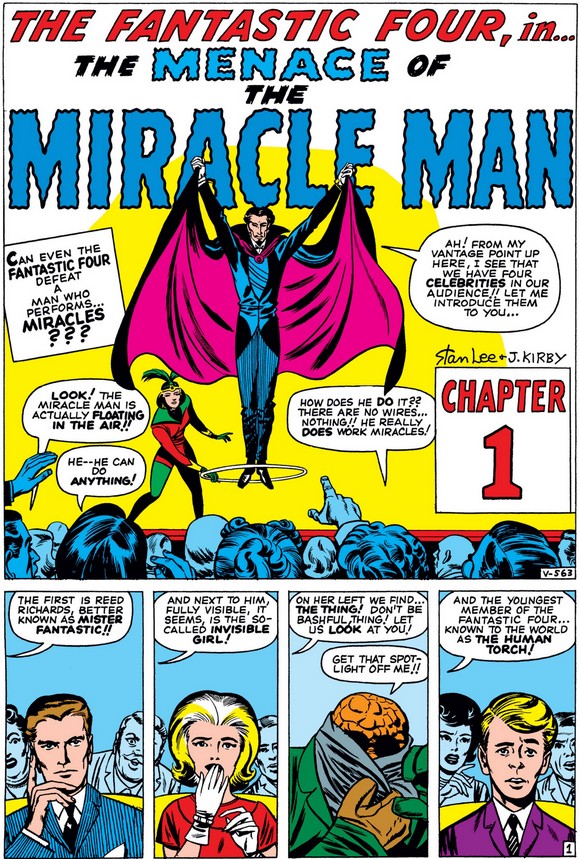
Again, he calls the Fantastic Four celebrities, which suggests (as noted in the last post) that they have had other adventures in between the ones chronicled in our world’s comics. Also, he seems to imply that Sue is misrepresenting her powers by not using them all the time—a luxury the “bashful” Thing does not have, of course.
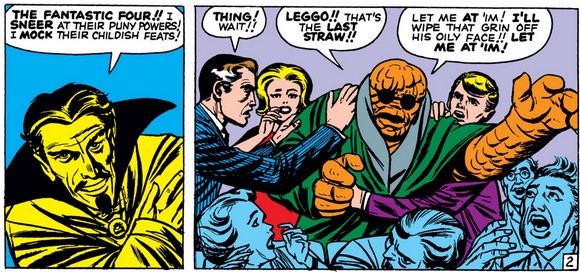
The Miracle Man broadens his verbal attack to the group as a whole, spending most of the next page showing off his own powers—changing his size, turning into a cloud, and summoning thunder and lightning—all in comparison to the Fantastic Four’s “puny powers.” This is too much for Ben, and the others once again are forced to hold him back…
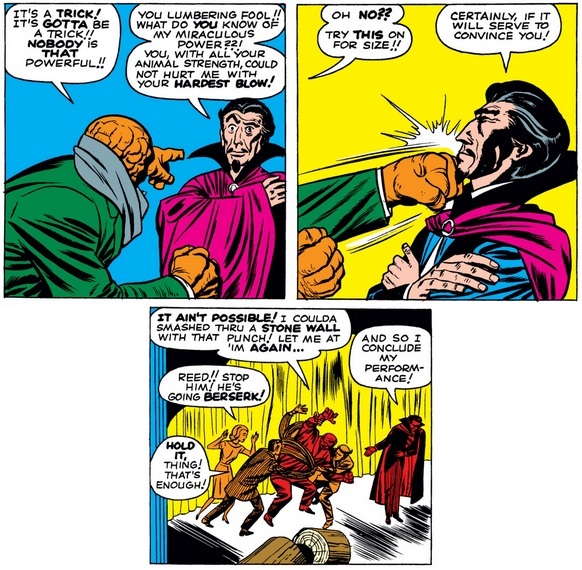
…and when the Miracle Man summons him to the stage to prove that even the Thing’s strength does not compare to his own, this forces the other three on stage to hold him back once again.
On their way home in the Fantasticar—not shown off very well below, but maybe Lee and Kirby felt the cover highlighted it enough—Reed thanks his lucky stars the Miracle Man is not a bad guy, because how could they possibly beat him if he were.
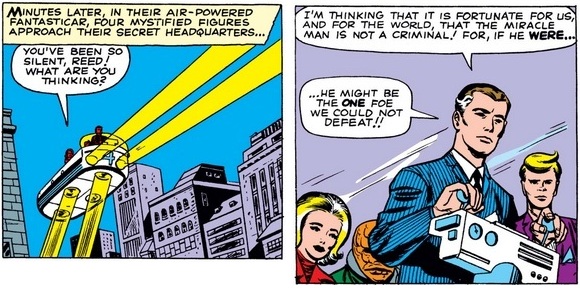
I appreciate that Reed’s willingness to admit his limitations, reflecting the humility that balances his optimism about his ability to solve any problem, is established this early on. At the same time, although it will be admirable when facing an existential threat like Galactus (as shown well in the recent film), it seems overly pessimistic here. (“Oh no, will we ever be able to defeat Paste-Pot Pete? He has so much paste!”)
While the Miracle Man is cackling away to himself about his evil plans, the group arrives at their new home, not yet identified as the Baxter Building (or in New York City, for that matter). We do learn that the Fantasticar has Smaht Pahk (as “a” Reed demonstrates to Captain America in this famous commercial) before we see a cutaway diagram of the top floors of the building, revealing that the Fantasticar is hardly their only means of transportation. (We can only assume there is a Fantasticatamaran in the basement.)
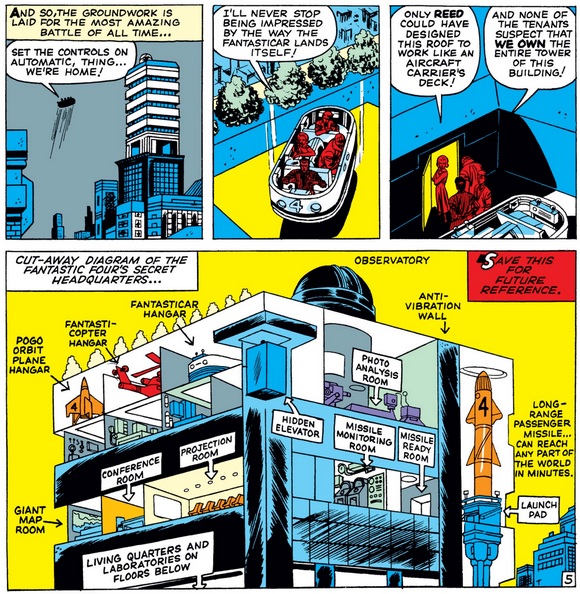
(Feel free to save this image to your device for future reference.)
As the men get ready to watch the New York premiere of “The Monster from Mars” on TV—complete with a huge model of Chekhov’s monster itself—Sue emerges from another room sporting a new outfit, following by an extreme close-up in which she says there’s one for each of them. (Ben, who was still in full disguise the entire time for some reason, issues a declarative “Bah!”)
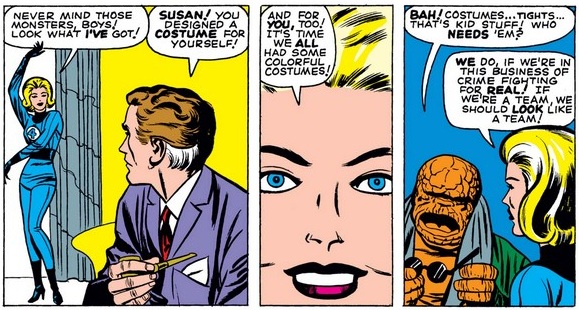
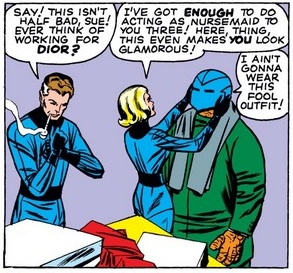
Reed approves, though, pre-empting Janet van Dyne’s eventual claim to be fashion designer to the superheroes, while Sue tells Ben he would look better if he only covered his face and head completely (and calling all three of them children in passing).
At his blog, Tom Brevoort shows original art from this issue, which has traces of Kirby’s erased pencil work that, when highlighted, reveals that Reed and Sue were originally meant to have masks (and their chest symbols were overlapping Fs, similar to Daredevil’s Ds):
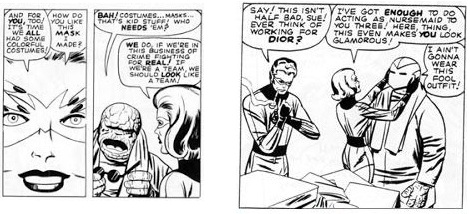
We can speculate that the intention was for these brand-new heroes (other than Ben) to have secret identities and that this plan was quickly abandoned (especially given the opening page, which may have been scripted differently earlier). This would have been very unfortunate, given that one of the many innovations of the Fantastic Four compared to other superheroes at the time (and earlier) was their very public identities (which could explain the initial impulse to keep them secret, as would remain an important element of many Marvel heroes to come).
During all of this, Johnny couldn’t take his eyes off the TV, where he witnesses the Miracle Man at the movie premiere and the giant monster coming to life and rampaging in the crowd before suddenly disappearing. This confirms Reed’s fears about the man’s nefarious intentions but does not prevent him from committing to stopping the threat, while Sue wants to use the Bat-phone before they go. (Yes, settle down, I know this comic predates that show.)
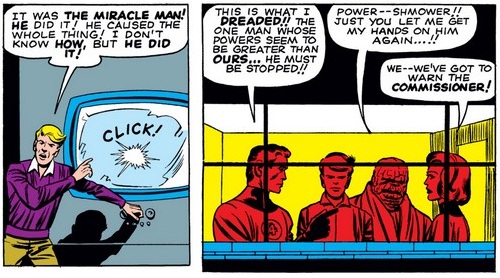
Just as they did with its first appearance in the book, they introduce one of the coolest features of the Fantasticar almost in passing.
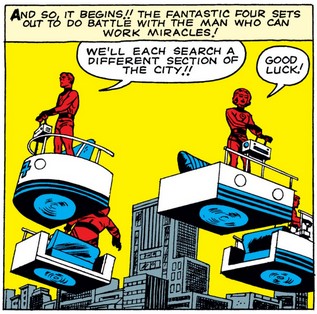
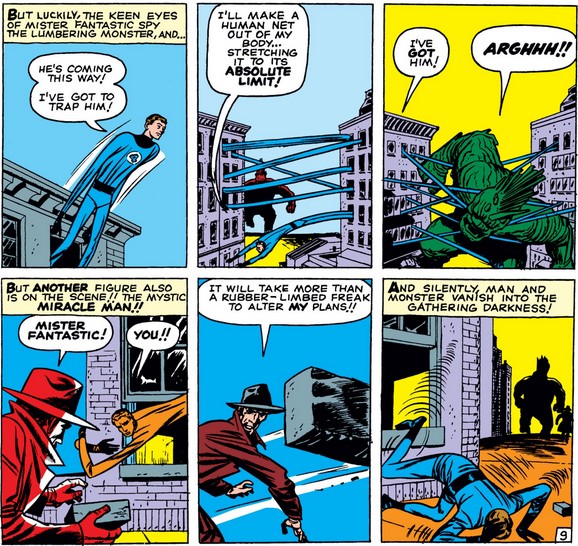
Each of the four tackles the reappeared monster separately, beginning with Reed, who demonstrates the tensile strength of his body even when stretched multiple times across two buildings—while leaving his head vulnerable to a thrown brick. Perhaps Reed could not spare the attention to make his head “rubbery” given the stresses on the rest of the body. (More much attention has been paid to the strain Sue’s powers put on her, as explained in chapter 3 of my book, and much less on Reed experiencing the same, other than when he reaches the limit of his stretching abilities, which is shown to be a physical strain more than a mental one.)
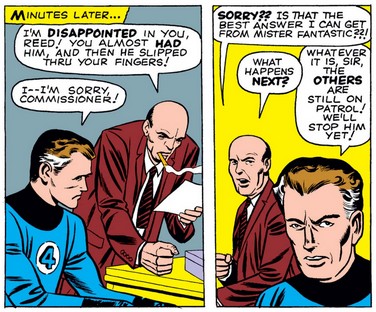
The police commissioner is surprisingly harsh with Reed, who seems rather ashamed of his performance. (And what’s with the paper he’s looking at? Did a young Peter Parker take a picture of the Miracle Man getting away and develop it already? Or did someone send him pictures of his wife canoodling with his best friend? That would explain his mood.)
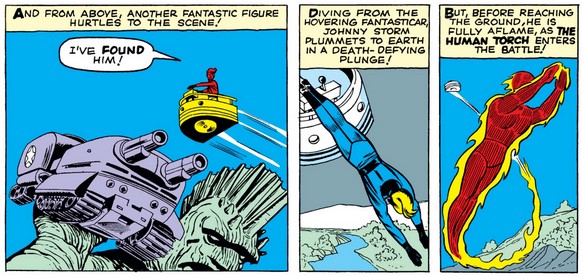
Next it’s Johnny’s turn, with the exposition highlighting his derring-do…
…and while he’s engaging the monster, Sue and Ben arrive, with the latter getting more comfortable before he starts clobberin’ (the time for which he will not mention for quite a while, I’m sad to say).
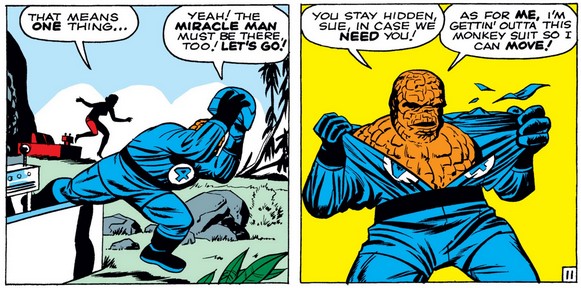
With a few exceptions (including later in this issue), this is the last we’ll see of the top half of Ben’s outfit, but he does wear the helmet again (or one similar to it) starting in issue #375 (after Wolverine gives his face a SNIKT).
After the Miracle Man defeats Johnny and Ben, Sue tells the others to back off and declares her intent to take care of the threat herself—hardly the behavior of a timid wallflower or “professional hostage,” as she is all too often mischaracterized.
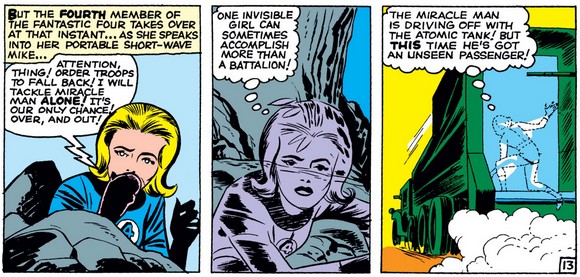
To their credit, neither Ben nor Reed seem too worried about her, and Johnny’s brotherly concern is understandable. (Had Sue made Ben another suit, or are we to believe the first one “miraculously” reassembled?)
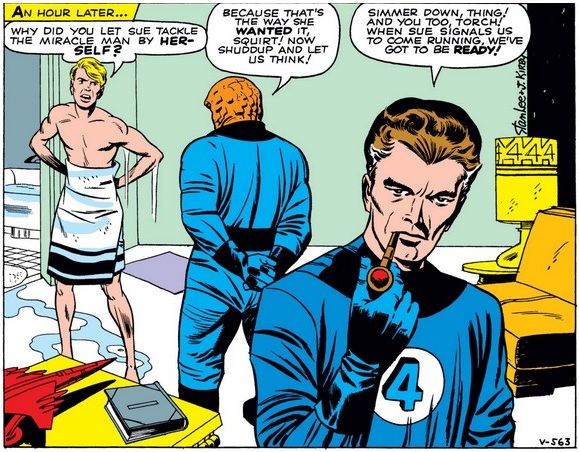
Ben takes advantage of the lull in the action to “remind” Reed and Johnny (and tell new readers) what happened in issue #1 (a memory he’ll never “burn,” as if it were so, so many years ago).
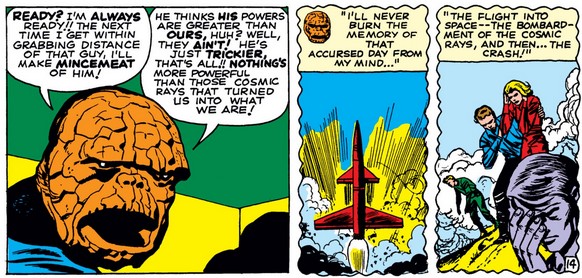
This recollection gives us Ben’s impressions of that “accursed day,” though he does not mention Sue naming him the Thing…
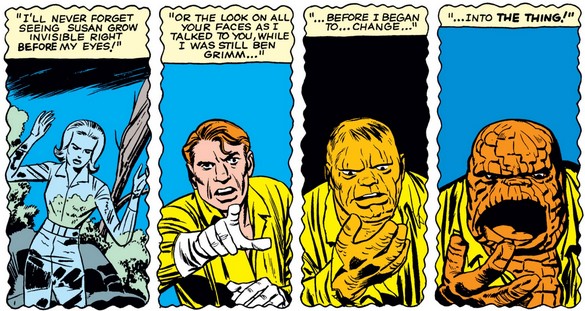
…nor does he explicitly blame Reed for it, even after Mr. Sunshine tries to put a positive spin on it all based on the good they can now do.
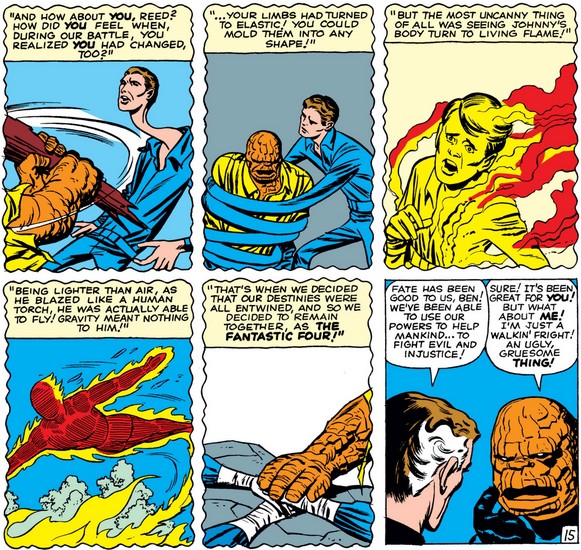
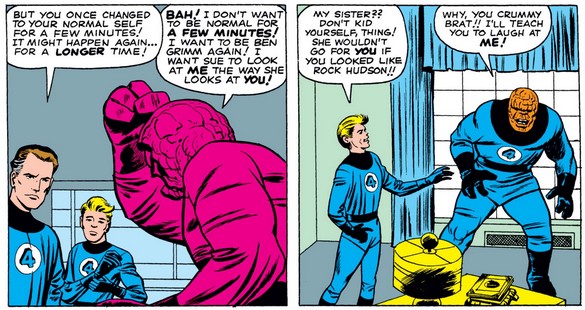
Reed tries to buck up his friend by reminding him of his temporary transformation to human Ben in the last issue—a change he will try to replicate many times over the coming years—and Ben replies by emphasizing not only that he only wants a permanent change, but also why. Unfortunately, Johnny steps on any response Reed might have given—couldn’t resist that Rock Hudson gag, I assume—and in the process gives us the first of many tussles between the two (most of them more good-natured than this).
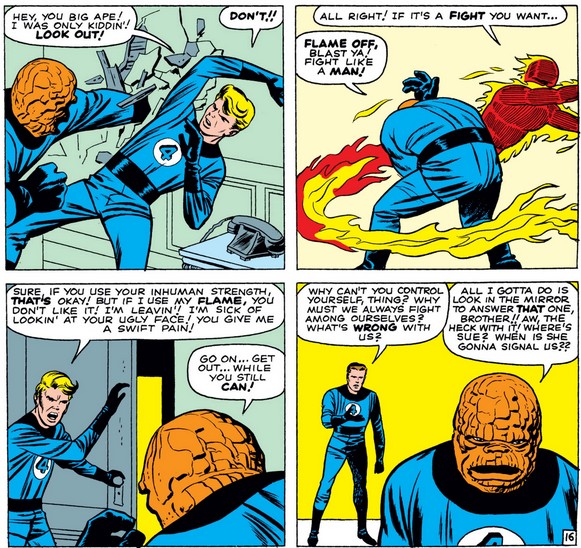
After a brief dispute regarding the fairness of using powers in their squabbles, Johnny storms out—pun intended—and Reed reprimands Ben before pondering the tensions amongst our four of them (which is another innovation of this new book and one the characters are aware of as well).
Meanwhile, Sue has arrived in the Miracle Man’s junkyard lair, complete with a junkyard dog that sniffs out the intruder. (That’s one Man who won’t doubt her powers again.)
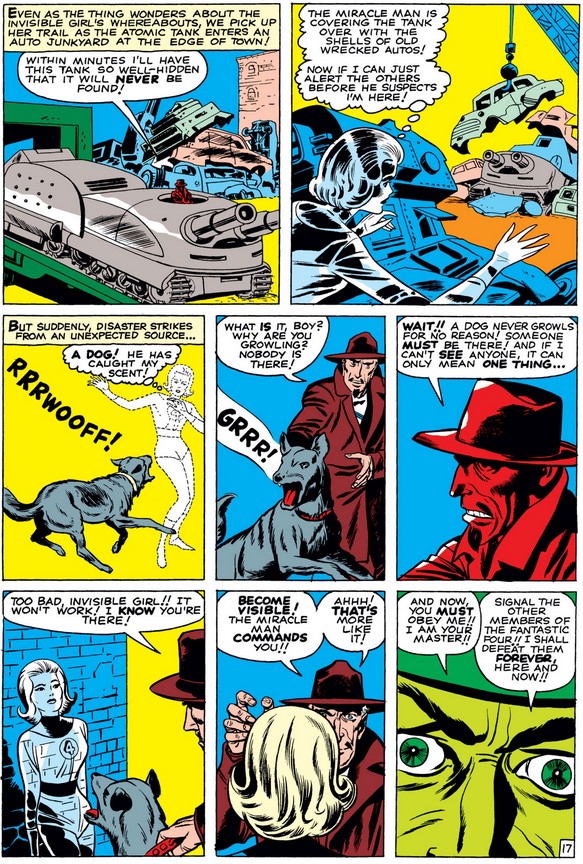
(Also, this is the first sign that he has powers of mental command or hypnotism, but not the last.)
The Miracle Man has Sue send up the signal flare, and the boys choose to take the Fantasticopter this time. (Note that Reed says their foe is too much for “one lone girl” to handle, when earlier he wondered if all of them could defeat him.)
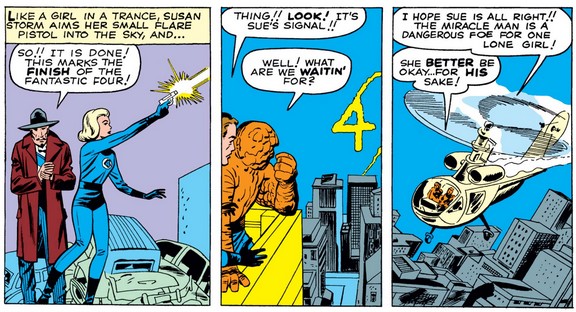
Johnny sees the flare too, from the corner soda fountain where he was catching up with Archie and Jughead.
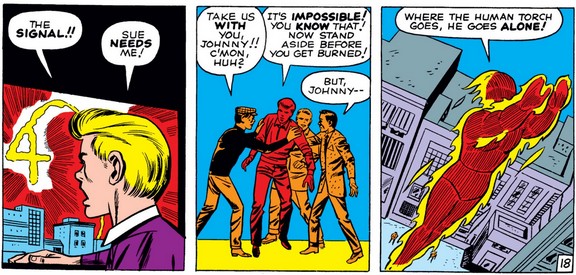
Above, Johnny gives one of my favorite dramatic superhero lines, “where [insert superhero name here] goes, he goes alone!” Here, he says it out of concern for his pals, whom he doesn’t want to hurt with his flame (an ongoing concern discussed in chapter 4 of my book). Usually, though, the hero says this out of concern for a loved one (as Daredevil usually does) or lamenting a solitary mission (as Doctor Strange often does). I think nearly every superhero has proclaimed some version of this at one time or another, as the nature of their lifestyles is an inherent danger to others, whether from their powers (as with Johnny), retribution from their enemies, or simply the danger they are drawn to (or attract).
When Reed and Ben get to the junkyard, the Miracle Man has a big key. (Look: It’s a really big key.) Reed assumes it must be more than a key, because what threat would a key be, unless he were Mr. Keyhole or Lieutenant Lock, and he is right (although it does make you wonder what the point of holding a key in the first place was).
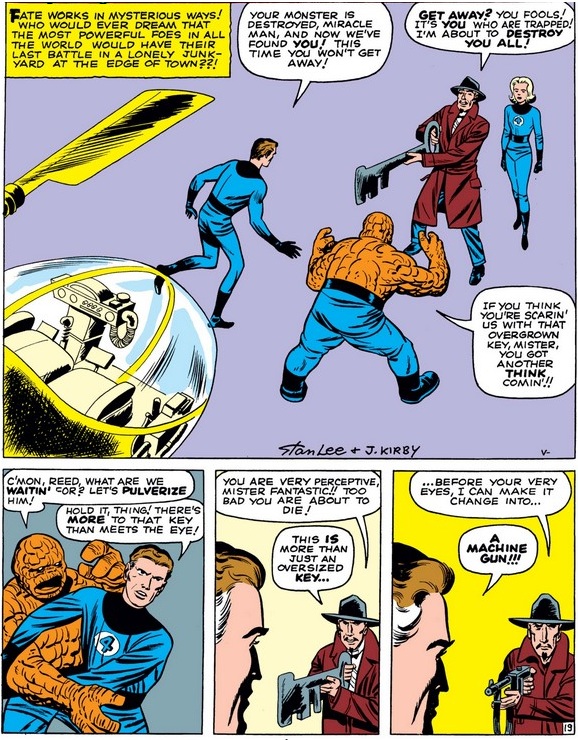
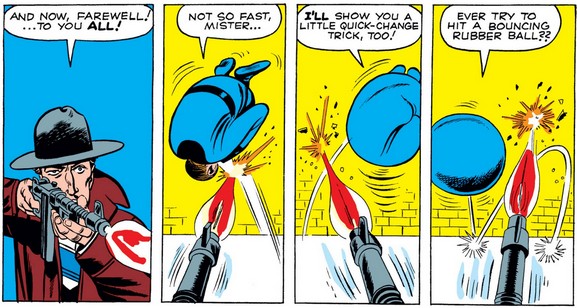
Here we see the first case of Reed doing something with his power other than stretch his limbs or neck. (He rarely engages in these kinds of transformations, which I associate more with Plastic Man’s lovable tomfoolery.)
For some reason, Ben is concerned that the bullets won’t bounce off of Reed—he might know about the brick—so he steps in between Reed and the Miracle Man, in what is the first act of overt heroism we see from him, but hardly the last. (So far, we have mainly seen him lash out in anger or languish in self-pity, but over time he embraces the heroic mission they agreed on, which also replenishes his depleted sense of self-worth.)
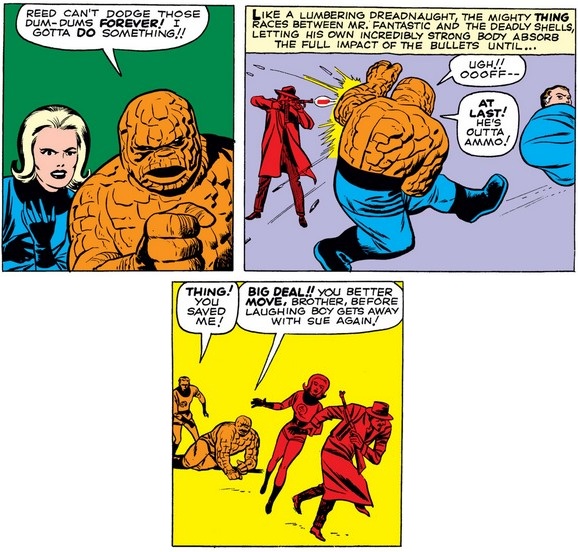
And how does Reed repay him? By calling him “Thing” instead of Ben (as we’ve seen them all do in these early issues, heartless as it seems).
The Miracle Man escapes in his stolen atomic tank after disabling the Fantasticopter, so the boys jump in an antique roadster, which gives Reed another opportunity to adapt to a problematic situation as only he (and Plastic Man) can.
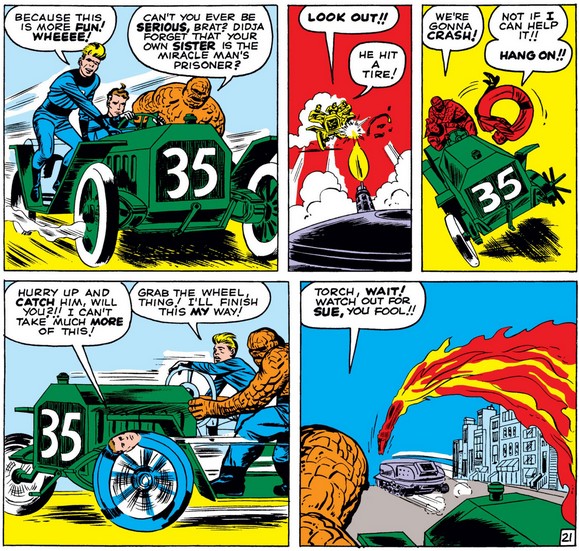
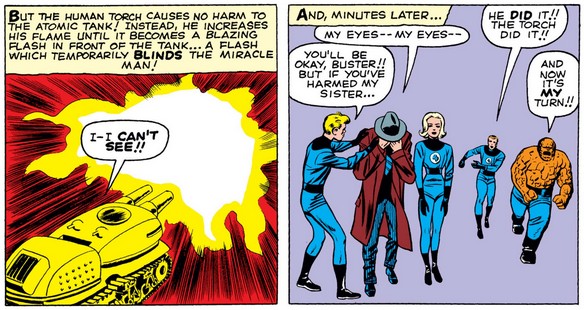
Although Ben gripes about Johnny’s impetuousness, the youth knows what he’s doing, and ends up beating the unbeatable foe.
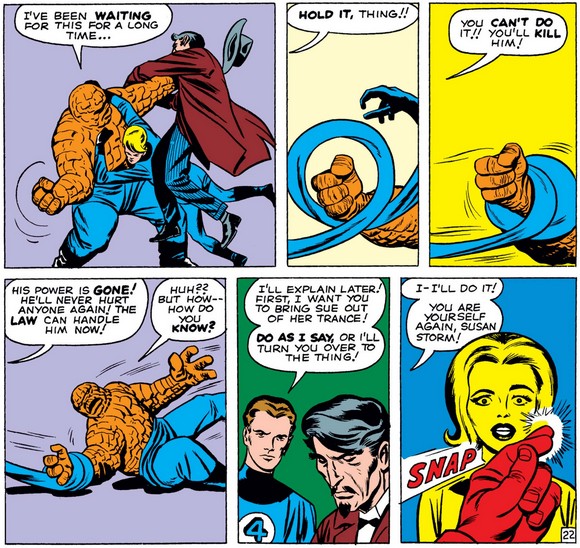
Like he did with the Skrulls in the last issue, Reed takes advantage of Ben’s rage to play “good cop/bad cop,” compelling the Miracle Man to release Sue from his trance…
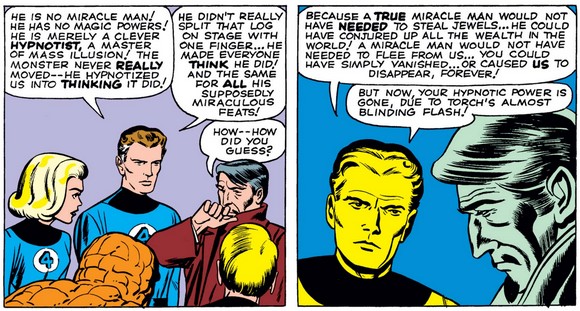
…before revealing the secret behind his “miraculous” acts. (This doesn’t make a lick of sense, given what we saw earlier, but neither does Reed’s logic, which resembles the failure of insight into the darker side of humanity that kept him from ever fully understanding Victor von Doom.)
But Reed did perceive the tensions amongst the four themselves, which must amuse the Miracle Man (“I let myself be defeated by these bickering fools?”), culminating in the first member to leave the group…
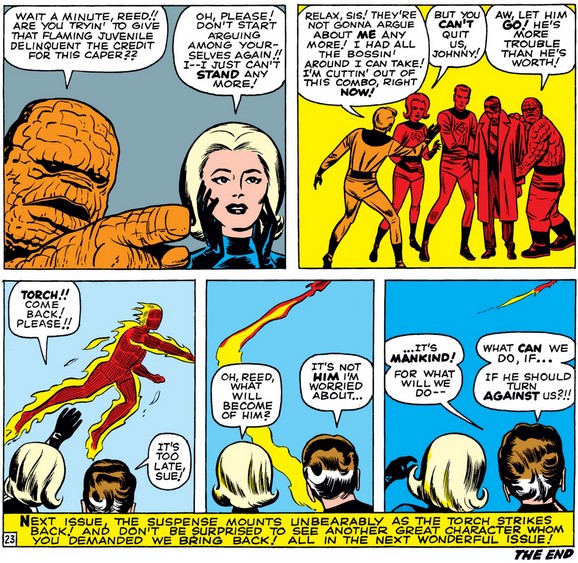
…as well as Reed worrying about the same thing as he did earlier with respect to the Miracle Man. (Be careful, Reed, or you’ll end up making secret plans to defeat all your fellow heroes should they turn evil.) For his part, the Miracle Man (whose real name is Josh, by the way, not that anyone asked) shows up now and again, but is not one of the FF’s more regular foes. (Unfortunately, the Wizard is.)
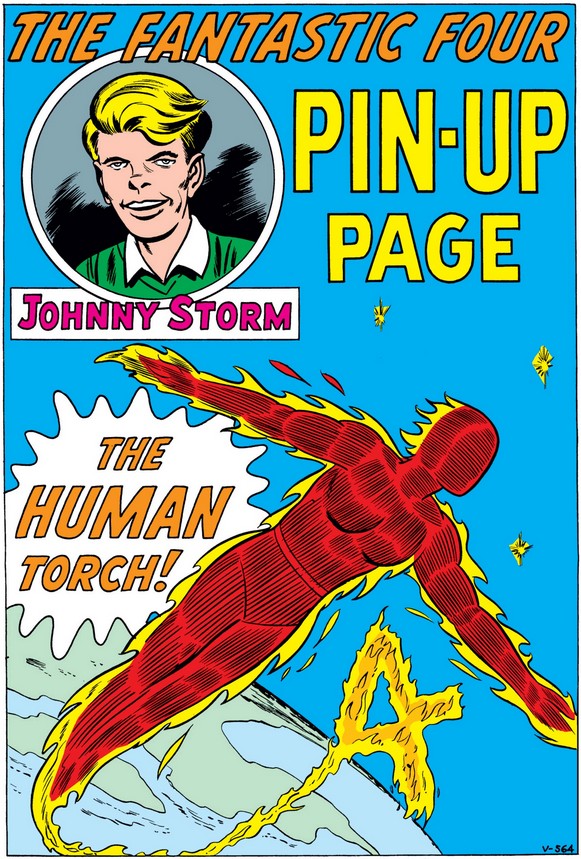
Again, this issue includes a pin-up, this time of Flamehead himself, who is still being drawn like the Golden Age Human Torch, with no visible facial features or lines showing his gloves and boots (although the cover does show them, an early sign of the future to come).
Resources for this issue:
- Marvel Comics (to read the issue online; free if you have Marvel Unlimited)
- Marvel wiki at Fandom (with detailed annotations and links to related comics)
- Fantastic Four: The Great American Novel (an amazing website with fascinating annotations)
- The Fantasticast (a wonderful podcast covering each issue one at a time)
- Tom Brevoort, longtime Marvel editor and tremendous comics fan and historian, compares the original artwork (which was not available for the first two issues) for this issue to the final product at his blog, and discovers the team’s masks (among other things).
- Print options:
- Fantastic Four Epic Collection: The World’s Greatest Comics Magazine (paperback collection containing issues #1-18)
- Marvel Masterworks: Fantastic Four Volume 1 (hardcover collection containing issues #1-10, also in paperback if you can find it)
- Mighty Marvel Masterworks: Fantastic Four Volume 1 – The World’s Greatest Heroes (same thing as above, in paperback and smaller trim size)
- Marvel Comics Library: Fantastic Four Volume 1, 1961-1963 (oversized hardcover containing issues #1-20 and extensive background notes, essays, and pictures)
- Fantastic Four: Penguin Classics Marvel Collection (faux literary collection containing assorted issues with a scholarly introduction)

 Here's the Thing...
Leave a comment